
Robert Redford Conservancy to Host SoCal’s First Agrivoltaics Conference
Farmers can learn how adding solar panels can conserve water, boost crop yields, and save money.
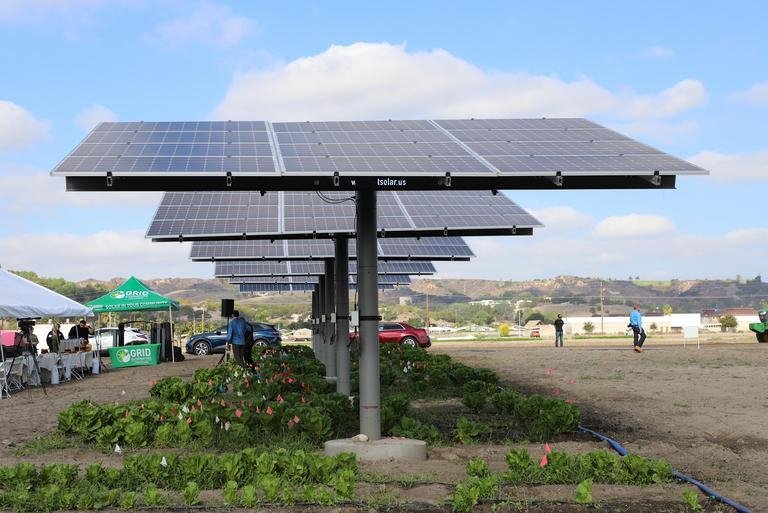
California represents the largest agricultural economy in the United States. It should be leading the charge in promoting agrivoltaics — solar panels installed on farmland to generate electricity and provide shade for crops.
What’s stopping California farmers from taking advantage of the many benefits of agrivoltaics? Mainly, the lack of widespread knowledge. Pitzer College and its Robert Redford Conservancy for Southern California Sustainability hope to address that by hosting Southern California’s first agrivoltaics conference on Tuesday, Oct. 20, at the DoubleTree Hotel in Pomona.

“The agrivoltaics community is growing,” said Rose Olivas ’22, the co-principal investigator for an agrivoltaics study that is a collaboration between the Redford Conservancy and Cal Poly Pomona. “It's really lovely that it's not just academia, it's community members, it's farmers, and it's solar-panel companies, engineers, construction, electricians, and teachers coming together. For this conference, I'm hoping that students, young people, old people, middle-aged people come and find innovative ideas to keep this idea rolling.”
The event will feature research presentations, panel discussions, and speakers from Pitzer, Cal Poly Pomona, UC Davis, and other institutions. The keynote talk will be delivered by Greg Barron-Gafford of the University of Arizona.
Attendees also are welcome to take a field trip to Spadra Farm a little more than a mile away. The quarter-acre patch of land, run by Cal Poly Pomona, is surrounded by larger research growing operations, as well as an organic tomato farm and a pumpkin patch. There are six solar arrays, made up of 12 panels each, standing about 13 feet above the ground, casting shade over a plot of romaine lettuce planted by students.
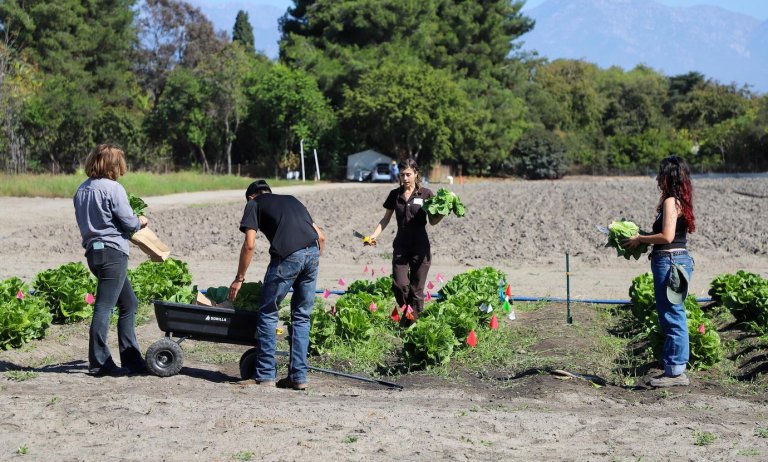
Spadra is the place where researchers from Cal Poly and Pitzer get a glimpse of what agrivoltaics can do for local farmers during a challenging period for the industry. Although the students and faculty are collecting data for a report that is not yet available, they have learned enough to make some useful observations: The shade keeps the lettuce heads from sprouting too quickly, which brings a bitter taste. Lettuce is a fall and winter crop, but planting during the hot Southern California summer months, with the shade from the solar panels, could extend the growing season and increase yields.
There also is less evaporation of irrigated water under the panels compared with the nearby “control” field that has no shade. “I can see in the field that water lasts much longer under the solar panels,” said Emily Kuhn ’22, farm manager of ecological resources at the Redford Conservancy who performs research at Spadra.
Other benefits to farmers who have deployed agrivoltaics technology include reduced electricity costs for irrigation pumps and other machines, because they can create their own renewable energy from the panels. (Another potential revenue stream is selling back electricity to the power company, as residents who have installed rooftop solar have done, although this revenue can vary.)
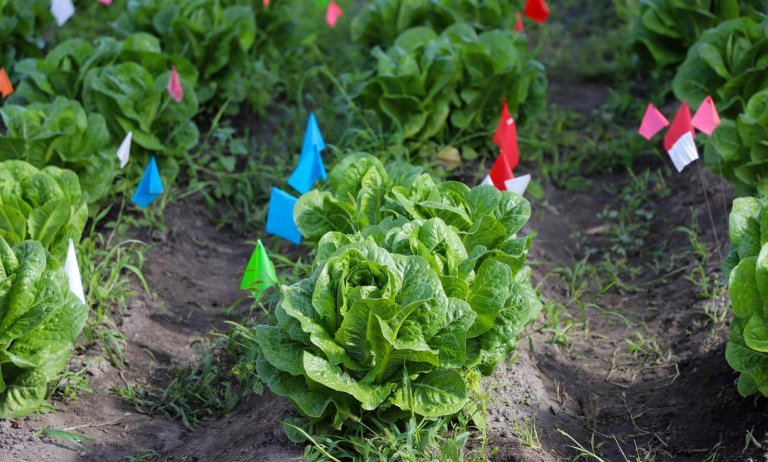
In addition, the shade and attendant water conservation provided by the panels can help facilitate microbes flourishing in the soil. This can enrich the soil’s environment and bring better fruits and vegetables.
“You need beneficial fungi in order to have a really beautiful symbiotic relationship with the plant,” said Olivas, who holds a BS degree in microbiology and chemistry from Cal Poly (2001), and an MS from Cal Poly in agriculture and plant science (2022). “There are fungi that live at the roots of a plant that feed off the sugar in what the plant secretes. In turn, that fungi can help bring in the nutrients from the soil and into the plant, so it helps the plant uptake the nutrients. So, we are looking to see if there are beneficial fungi that remain in the soil under agrivoltaics, compared to the soil directly into the sun.”
Kuhn, who earned a bachelor’s degree in environmental sociology, said California has a long way to go to catch up with states like Illinois, Colorado, Massachusetts, and New York that have made gains in advancing agrivoltaics technology.
“It starts with awareness and research and some commercial pilot projects,” she said. “Farmers are very savvy at business, and when they see a solution like this, they get excited and want to make it happen. There will be some brave entrepreneurs who will start that wave in California, and from there I think it’s just a matter of adapting the political world to make it more accessible.”
News Information
Published
Author
Landon Hall
Organization
- Robert Redford Conservancy for Southern California Sustainability
News Type
Share This
Related News
All News