Pitzer Celebrates Inaugural SoCal Agrivoltaics Conference
Attendees exchange ideas and promote solar energy as a boon for farmers and the planet.
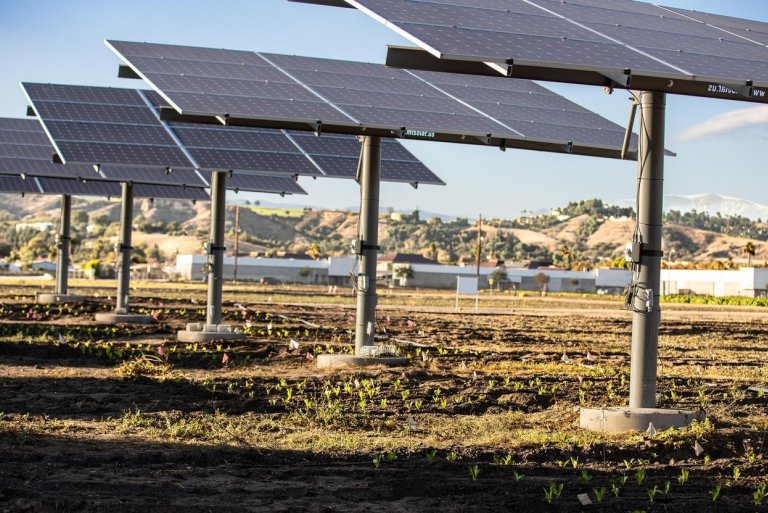
The agrivoltaics movement — a coast-to-coast effort to combine solar energy with agriculture — is gaining momentum. And Pitzer College is now right in the middle of it.
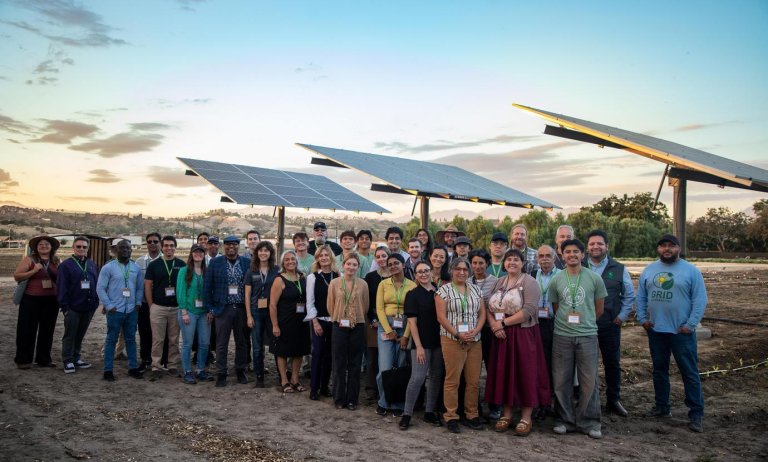
Pitzer College hosted the first agrivoltaics conference in Southern California on Oct. 20, in Pomona, Calif., and organizers were thrilled at how it went: More than 60 people attended the daylong gathering, the first of its kind to be held in Southern California. It featured informative presentations, a free-flowing exchange of ideas, and a consensus that the technology is on the verge of breaking through in farming communities all over the country.
“It is beyond what we hoped for,” said Guillermo Douglass-Jaimes, interim director of the Robert Redford Conservancy of Southern California Sustainability, and a visiting assistant professor of environmental analysis at Pitzer. “I'm hearing all these side conversations, all the plans that are moving forward, and it's just fantastic.”
The 60 or so people who attended the conference represented the spectrum of stakeholders in agrivoltaics: academics, farmers, activists, solar-power industry owners and reps, and lobbyists.
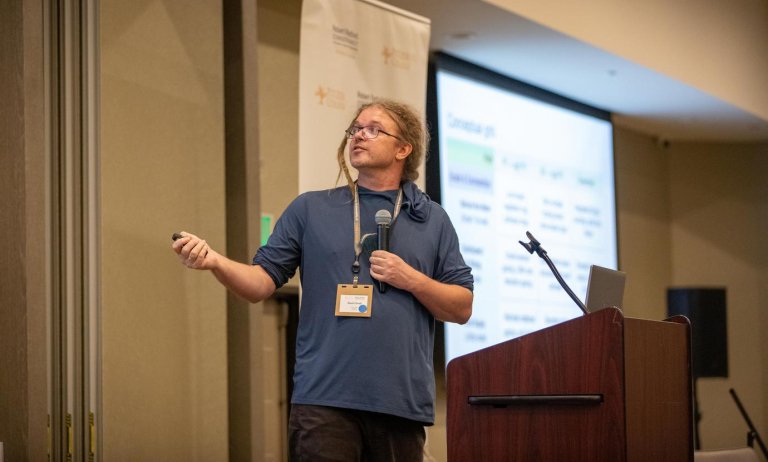
Although the cost component of agrivoltaics played a strong role in the day’s programming — Kevin Grell, an adjunct assistant professor in economics and environmental analysis at Pitzer, delivered a detailed presentation on the economic viability of agrivoltaics — conservation was just as prevalent a theme: the idea that agrivoltaics can help reduce the carbon intensity of growing food.
“Environmental sustainability and social responsibility are two of Pitzer's core values, and they have been central to our identity since our founding,” Pitzer President Strom C. Thacker said at the opening of the conference. “We believe that higher education has a responsibility not only to deepen our understanding of the world's most pressing challenges, but also to help address them.
“And that work is most effective when we bring together different perspectives and areas of expertise. Agrivoltaics is a wonderful example of that approach, connecting agriculture, renewable energy, environmental science, and community needs in ways that can benefit both people and the planet.”
The day’s speakers and panelists outlined the benefits of agrivoltaics, including:
The shade cast from solar panels reduces the amount of water needed for irrigation.
That shade can improve the product itself. Constant sunshine doesn’t always mean higher-quality and better-tasting fruits and vegetables. Some tomato connoisseurs, for instance, say the most flavorful ones have a near-equal distribution of sugar content and acidity. Carefully controlled shade can optimize these levels, improve harvest yields, and extend growing seasons.
The electricity generated by a solar array can run farm equipment like irrigation pumps, reducing utility bills.
Some of that electricity can be put back into the power grid, as with rooftop solar, providing extra income for farmers.
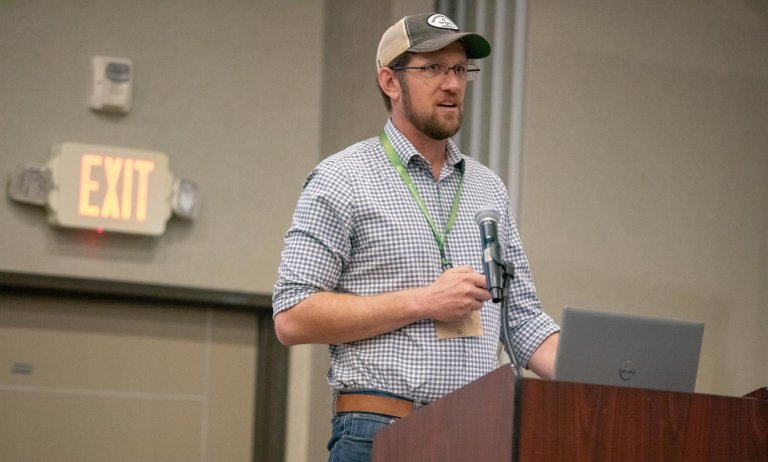
A farmer from Colorado, Byron Kominek, told the story of how his family turned a 5-acre parcel of his family’s 24-acre farm into a working laboratory for agrivoltaics called Jack’s Solar Farm (so named for his grandfather Jack Kominek). His setup cost about $2 million to build. Although he does enjoy revenue streams from the solar-generating capacity, including raising cattle that roam under the panels and hosting tours of the property, the main reason he got involved with agrivoltaics was not money.
“It was more values,” said Kominek, who previously worked as a diplomat for the U.S. Agency for International Development and served in the Peace Corps in Cameroon. “We, as a society, have our natural resources and we have our people. We’ve got to figure out how to do good by them both. This is an opportunity to do good by them both, all on the same piece of land. It’s useful for society to think about it.”
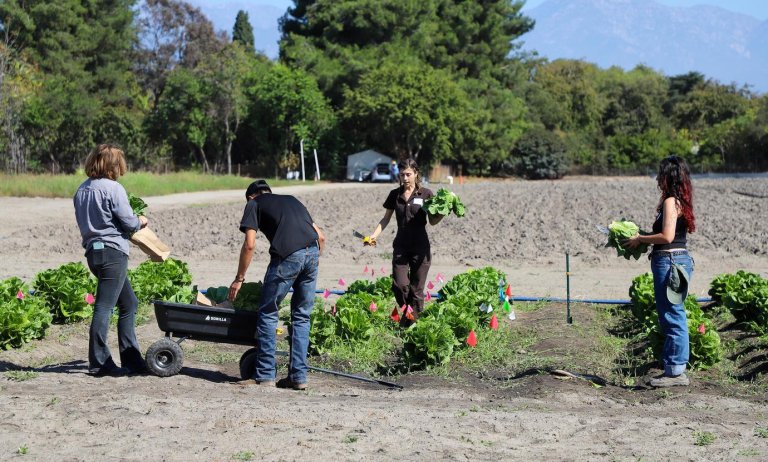
Pitzer and Cal Poly Pomona (CPP) are thinking about the issue, and studying it, on the patch of land at Spadra Farm where a team is growing Romaine lettuce — some under solar panels and some out in the sun. Conference attendees went on a field trip to the farm and saw the lettuce plants recently put in the ground. Pitzer and CPP students, faculty, and staff team up to tend to the plants and take measurements. The tour was led by Emily Kuhn ’22, FFAR manager of ecological resources at the Redford Conservancy, and who manages operations at Spadra.
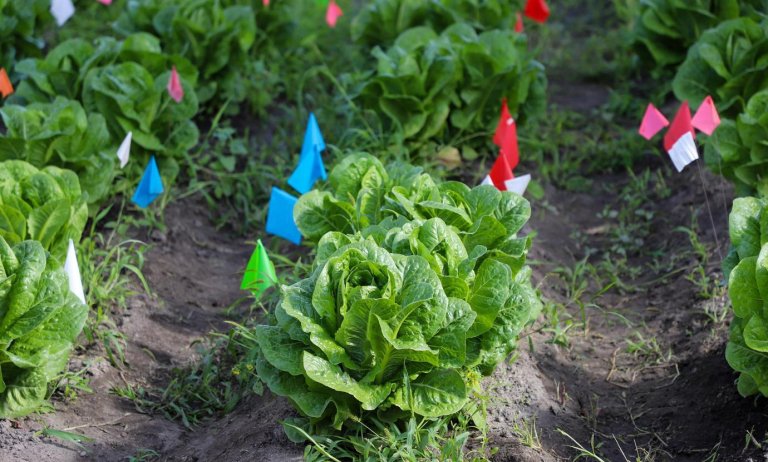
The heads of lettuce will be harvested in December, the seventh and final growing season under a $1.8 million grant from the Foundation for Food and Agriculture Research (FFAR), said Eshwar Ravishankar, an assistant professor of plant science at CPP who is conducting a study based on the data collected at Spadra. The study is a collaboration between CPP and the Redford Conservancy; Rose Olivas from the Redford Conservancy serves as a co-principal investigator and was instrumental in organizing the conference.
There is new funding on the way: Ravishankar said that a $100,000 grant from the California State University system’s Agricultural Research Institute begins in January, and a $2.1 million grant from the California Energy Commission begins in April. Ravishankar hopes to try growing different varieties of leafy greens that are more heat-resistant, like iron-rich amaranth.
Douglass-Jaimes said such research is vital because of the heat waves and extreme weather events that have become more frequent, driven by climate change.
“California has been an innovator in so many fields, and yet we are lagging behind in this,” he said. “So we're kind of playing catch-up but also learning from all those who have come before us so we can make this technology sustainable for us here in Southern California.”
News Information
Published
Author
Landon Hall
Organization
- Robert Redford Conservancy for Southern California Sustainability
News Type
Share This
Related News
All News