Addressing the Gap in Women’s Sports
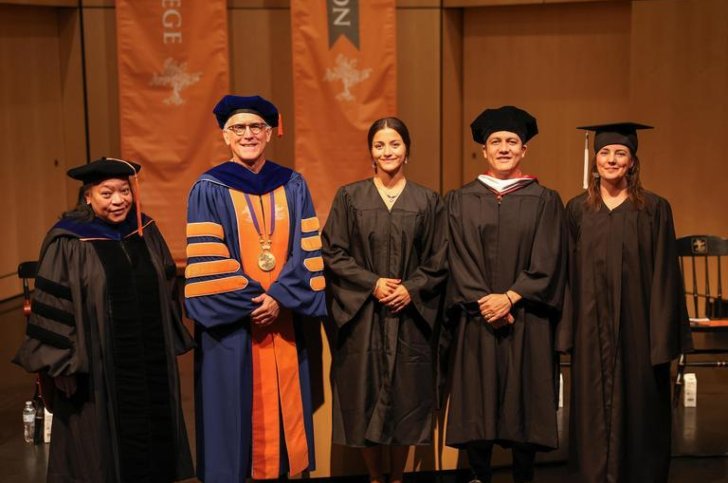
With faculty and Pomona-Pitzer Athletics’ support, Eva Novy-Hildesley ’27 self-designed a sports science major to empower women’s health and fellow female athletes.

Injuries and a hormonal imbalance almost derailed Eva Novy-Hildesley’s ’27 collegiate track career. She was competing in a Division I program when she began struggling with health issues. Feeling as if she wasn’t receiving the full range of care she needed, she took her health into her own hands.
“The lack of support led me to research my own [body] system, and through that experience I became curious about what we still don’t know about female athletes,” said Novy-Hildesley.
Novy-Hildesley knew she wanted to study sports science when she transferred to Pitzer. Although the College doesn’t have a sports science program, it did offer another opportunity: a self-designed major. Novy-Hildesley incorporated psychology, nutrition, physiology, anatomy, and kinesiology to create her own intensive curriculum.
Novy-Hildesley developed her major to address two gaps facing women in sports: a lack of scientific research and a lack of an empowering social narrative. Only 6% of sports science research focuses on women in sports. Societally, Novy-Hildesley said that “we are still pushing back against a narrative that strength and femininity are mutually exclusive.”
Many disciplines, one sports science major
With a hope of holistically addressing performance optimization, long-term health, and empowerment in female athletes, Novy-Hildesley has explored many disciplines. Her classes include Physiological Psychology, Human Anatomy and Kinesiology, and Nutritional Biology. Drawing from so many academic fields is intentional.
“Barriers to women in sports are interdisciplinary, and the solutions also need to be interdisciplinary,” said Novy-Hildesley. “And it’s not just addressing the lack of science.”
Novy-Hildesley pointed out how media coverage, beauty standards, and social pressures affect girls and women in sports. In a study she conducted with the non-profit Wildwood Running, Novy-Hildesley shared several statistics: 71% of girls feel concerned about their body image; 67% say their mental health suffers in and around sport; and 43% have restricted their food. Novy-Hildesley herself has faced catcalling on runs, in addition to comments about how she shouldn’t become “too muscular.”
With support from the Pitzer Internship Fund, Novy-Hildesley interned at ROKKE Performance Therapy this summer. By attending lectures and doing practical training, she built her understanding of data-driven strategies for return-to-sport and performance optimization. She used technology and data to analyze quad strength discrepancies over time in ACL recoveries and left/right imbalances in injured athletes.
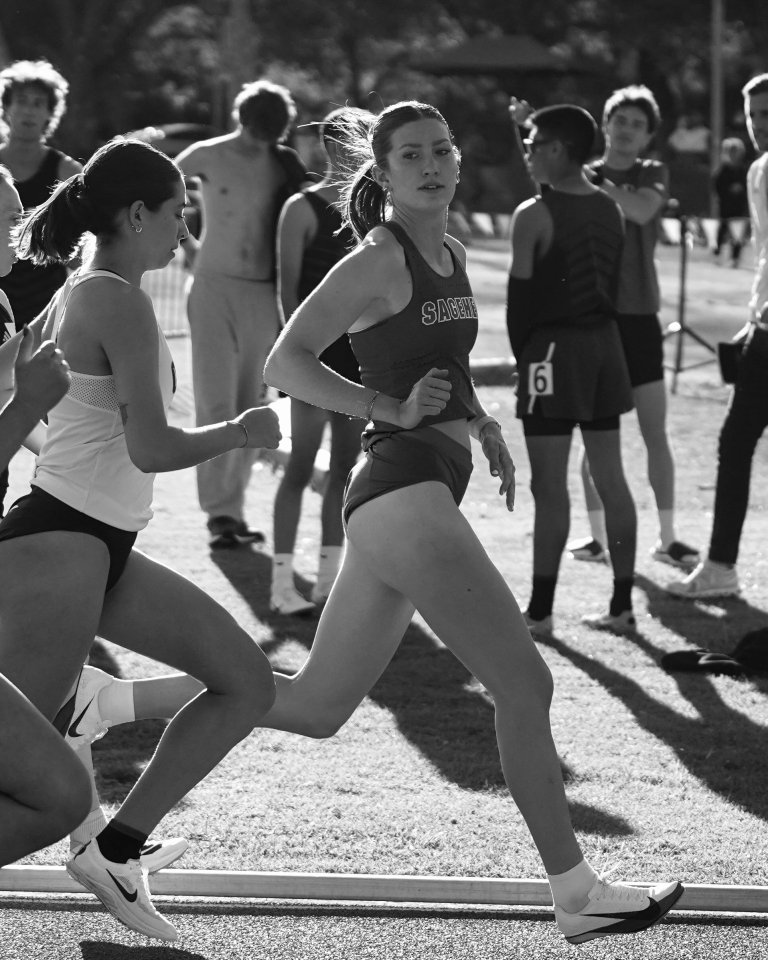
Novy-Hildesley knows complex problems, like women athletes’ health, require complex solutions. That’s why Pitzer’s core value of interdisciplinary learning has been formative to her liberal arts education. She understands issues at the micro- and macro-level.
“Everything is complex and needs to be interdisciplinary if you want to have a true understanding of things,” said Novy-Hildesley.
More than “just sports”
Earlier this fall, a sports betting ad reminded Novy-Hildesley why her research matters.
Posing with two footballs to cover her nudity, actress Sydney Sweeney advertised Novig with a deceptively simple tagline: “Just Sports.” The campaign caused backlash from women athletes nationwide.
Novy-Hildesley competes on the Pomona-Pitzer women’s track and field and cross-country teams. Drawing from her athletics experience and sports science curriculum, Novy-Hildesley addressed Novig’s campaign in an op-ed in The Student Life newspaper.
“Ads like this work, but it’s worth considering how and why we have normalized using the sexualization of women as a selling point, and in this case, doing it at the expense of female athletes to pull a predominantly male audience,” wrote Novy-Hildesley.
Novy-Hildesley argued that sports have never been “just sports” for female athletes, despite how Novig minimizes it as a casual topic for men to bet on. Novig’s ad reflects the larger issue of objectifying women to attract the male gaze and make a profit.
“It’s about how society shapes what we value in women, and about the ongoing, critical work ahead to provide education, opportunities, and empowerment to girls in sport,” said Novy-Hildesley.
Campus community support
Novy-Hildesley’s faculty advisors, Associate Professor of Biology Jenna Monroy and Assistant Professor of Neuroscience Thomas Borowski, provided key support for her self-designed major.
“I’m working with Professor Monroy on my thesis right now, which is going to be about the underutilization of strength training in female athletes and how that leads to long-term bone density and injury risk,” said Novy-Hildesley.
This is not just a health issue for women athletes. Novy-Hildesley said that women can start losing bone density in their 20s if they aren’t strength training. In her thesis, she plans to discuss the social as well as physical problems that prevent women from strength training.
“People don’t want to be bulky, or they’re too scared of the weight room, or they just aren’t prioritized that way by coaches,” said Novy-Hildesley.
Novy-Hildesley’s teammates and coaches at Pomona-Pitzer Athletics have also supported her journey.
“The team is super close knit,” said Novy-Hildesley. “The coaches are incredible in terms of supporting us as people and understanding us as people, not just athletes.”
Head Cross-Country Coach Kirk Reynolds once told Novy-Hildesley that the biggest difference between Division I and III collegiate athletics is that everyone is here because they want to be. Students and coaches face less high-stakes pressure in a DIII environment. Novy-Hildesley has seen the results in Pomona-Pitzer Athletics.
“It truly is an authentic buy-in, and I think that creates a really beautiful culture that I’ve been very lucky to be a part of,” said Novy-Hildesley.
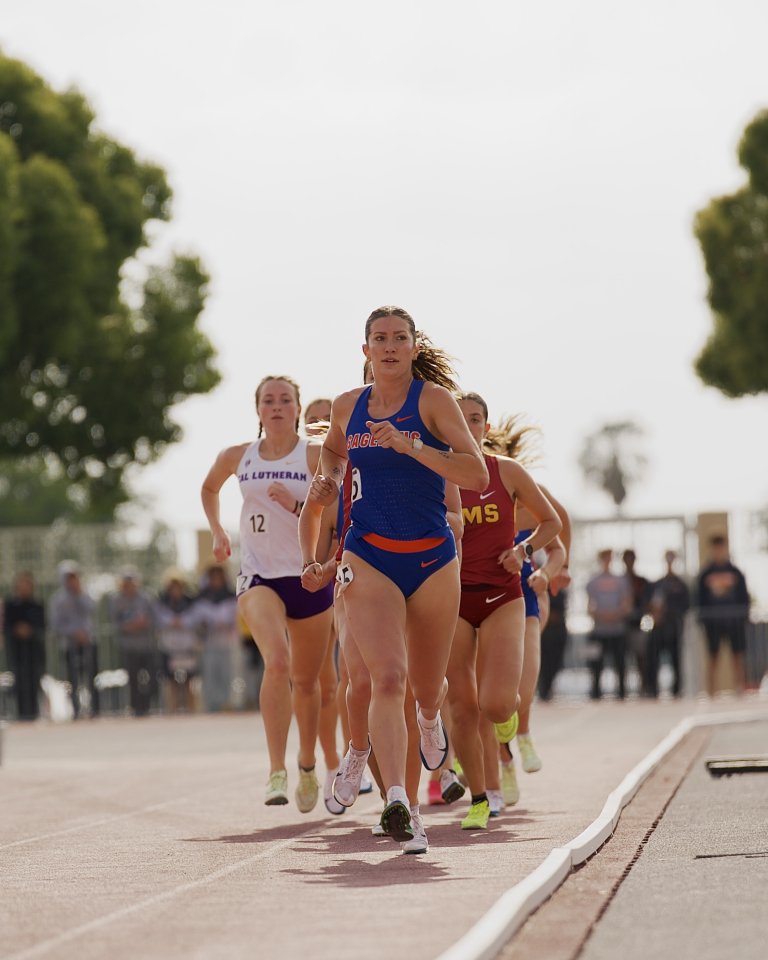
Novy-Hildesley serves as a co-captain of the women’s track and field team, which earned the second-highest GPA in DIII in 2025–26. This accomplishment reflects how Pomona-Pitzer enables students like her to thrive in their classes.
Pomona-Pitzer athletic trainers have also shown Novy-Hildesley how to support athletes’ recovery from injuries. Their mentorship gives her practical experience in physical therapy if she decides to pursue that occupation.
When she transferred to Pitzer, the athletics program was not the only place where Novy-Hildesley found belonging. She also found friends in the broader campus community.
“People were very welcoming of me,” said Novy-Hildesley. “I think also being in a smaller school environment where faculty are very involved too... you get to know people, they get to know you, they’re reaching out. It was a positive experience.”
News Information
Published
Author
Bridgetter Ramirez
Organization
- Sagehen Athletics
- Department of Natural Sciences
News Type
Related News
All News