Student Leader at the State Capitol
Supported by Pitzer staff and faculty, Kaitlan Sakuma ’29 takes on a new role at the California Student Aid Commission to make higher ed affordable for all.
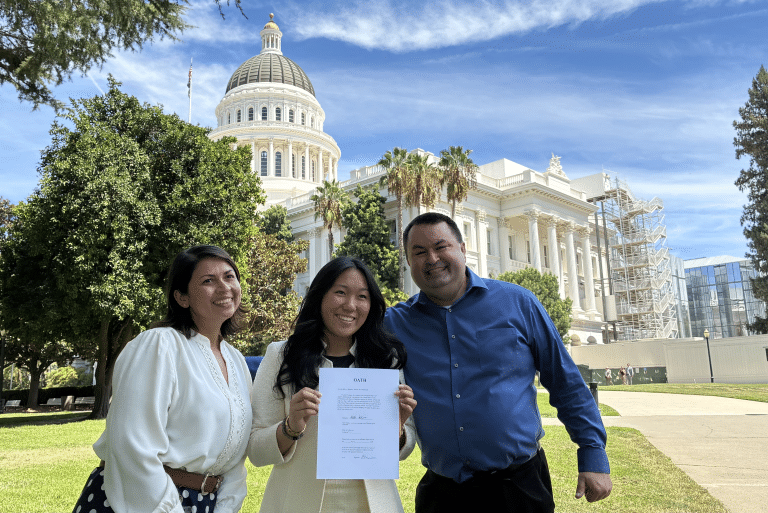
Kaitlan Sakuma ’29 has become a statewide advocate for affordable higher education. She is one of two students appointed by Gov. Gavin Newsom to the 15-member board of the California Student Aid Commission (CSAC), which administers financial aid for post-secondary education.
CSAC seeks to make universities, colleges, and vocational schools affordable for all Californians by providing resources and driving policy reform. A lifelong resident of Monterey Park, California, Sakuma is excited to begin her two-year term on the commission and offer a student perspective for decisions at the state level.

“I am passionate about ensuring student voices are being holistically represented within the decisions that shape their educational journeys,” said Sakuma. “We’re working toward a sustainable system that can support everyone. I hope to bridge the gap between the system and the students, and ultimately, create an environment in which higher education can be easily navigated.”
Sakuma noted that after their first year in college, many students typically don’t receive as much financial aid guidance. She hopes to build relationships with students across the state, spreading awareness of CSAC’s resources and making financial aid feel less intimidating.
“Changing the system starts with connection,” said Sakuma.
Education Advocacy in Practice
CSAC is not Sakuma’s first time being a student voice at the California Capitol. Last year, she engaged in ICCAP, the Association of Independent California Colleges and Universities’ Student Advocacy Program. She and two other Pitzer students spent a day in Sacramento, talking to legislators about the Cal Grant and advocating for making higher education financially accessible.
A Pitzer alum later introduced Sakuma to the Center for Asian Americans United for Self-Empowerment (CAUSE)’s Leadership Academy. Through CAUSE, Sakuma interned at the office of Assemblymember Mike Fong, a Democrat from Los Angeles who chairs the Higher Education Committee. There, Sakuma deepened her experience with education advocacy in the legislative realm. This experience became pivotal when she interviewed for the CSAC commissioner position.
Sakuma’s passion for making college accessible is based on her own experience. In addition to financial aid, she has benefitted from a variety of tailored support at Pitzer—from office hours with faculty to academic coaching.
“At Pitzer, I have received individualized support from staff and professors who sincerely want to help me succeed,” said Sakuma. “That support has been critical in my college and career journey.”
Sakuma named several examples. Her academic advisor, Professor of Psychology Mita Banerjee, has offered longstanding reassurance and advocacy. Moreover, faculty members Adrian Pantoja (Political Studies) and Justin Huft (Sociology) have provided significant guidance in Sakuma’s academic and professional trajectory. Sakuma has also built trusting relationships with staff members Dominique Acosta and Tasmia Moosani. Acosta is the director of Pitzer’s Center for Asian Pacific American Students (CAPAS), and Moosani is the associate dean of student success.
“Staff members have continuously opened their doors for students and always provide a warm welcome,” said Sakuma. “They share lived experiences that reaffirm our sense of belonging in higher education.”
Living Out Student Engagement
Sakuma chose Pitzer instead of a public university because she wanted one-on-one support from a small, liberal arts environment. Pitzer also offered her an active student government and five core values that reflect a culture of changemaking.
Sakuma is especially drawn to Pitzer’s core value of student engagement. She is a sophomore class representative in Pitzer’s Student Senate, a co-president for the Pasifika Asian Student Union (PASU), and a CAPAS staff member. These roles are just a few of the ways that she leads and advocates for the collective good on campus.

“Advocacy to me is ensuring that students aren’t just being spoken for but are actually in the room speaking,” said Sakuma. “At the end of the day, we should all have a hand in directly shaping the communities that shape us.”
News Information
Published
Author
Bridgette Ramirez
News Type
Related News
All News