Wunderkammer
January 24–March 26, 2015
In contrast to current museological models that derive their practices from their nineteenth-century counterparts, the wunderkammer—generally regarded as a prototype for the first museums—can provide an alternative. Distinguished by their eclectic and all-encompassing collections, these early museums celebrated heterogeneity and difference as accolades—objects collected ranged from functional everyday artifacts to biological anomalies. Their interdisciplinary and all-inclusive practice resulted in a non-hierarchical approach; value was assigned according to the object’s polyvalent signifying power, its ability to be endlessly interpreted rather then categorically determined. As their name suggests, these museums championed wonderment as a vital tool for knowledge acquisition.
By providing a different rubric, these early models can offer an alternative lens to critique prevailing exhibitionary practices by calling attention to the codes and conventions of current display strategies, chronological placements, and exhibition typologies. By interrogating these classificatory norms it is possible to examine how these taxonomic structures dictate behavior in other areas of our lives—labor, leisure, culture—and by extension their impact on how we self identify or are identified by others—race, class, sexuality, gender. As a result, the wunderkammer model provides an opportunity to examine how knowledge is produced and disseminated, controlled and manipulated.
Through the objects and installations, the artists and practitioners in the exhibition explore these ideas through the production of archives—fictional and real; via unique and eclectic cosmologies; by privileging the mundane and forgotten above the conventionally celebrated; the historical as a part of the contemporary; and the nonprofessional versus the established. Furthermore, through the use of specific representational systems these artists reveal and critique established ideological constructs that govern issues of inclusion and exclusion within the contemporary museum.
Wunderkammer is a set of connected exhibitions at Pitzer College’s Nichols Gallery and Barbara Hinshaw Gallery, and the First Street Gallery Art Center of the Tierra del Sol Foundation.
About the Artists
David Bachmanis a professor of mathematics at Pitzer College in Claremont, CA. He received his PhD in 1999 from The University of Texas at Austin and has since published 16 research articles and two books on geometry and topology. For the last 25 years, Bachman has also enjoyed a number of non-academic pursuits, from lighting design for nationally touring musical acts to building furniture. Six years ago, Bachman’s background in mathematics and his affinity for working with his hands converged when he began to experiment with 3D printing and design. Since then he has created unique mathematical sculptures by using several CAD modeling packages (Rhino 3D, Grasshopper), a variety of 3D printers and a garage full of tools.
Joshua Callaghanis a Los Angeles–based artist working in installation, sculpture, video and public art. He received an MFA from UCLA in 2005. He was also the recipient of a Fulbright Grant to Nepal. His work has been exhibited nationally and internationally. He has also completed a series of public projects in Southern California, New York City and Taipei.
Chris Cobbis an artist and writer based in New York. His work comprises installation, photography and text. In addition to working as an artist he has worked as a teacher, a chef, an obituary researcher, an antiques seller, a designer and a DJ. His work has been shown at MASS MoCA, Massachusetts; ATM Gallery, Berlin; ONETWENTYEIGHT Gallery, New York; the UC Berkeley Art Museum; Adobe Bookshop, San Francisco; Timberspace, Los Angeles, and others.
Michael Decker is a Los Angeles–based artist whose body of work spans an array of media: installation, drawing, sculpture, video and performance art. Decker received a BFA from California Institute of the Arts (CalArts) in 2005. His process involves sourcing the peculiarities of contemporary Americana to create intuitive forms made in response to the materials’ physical limitations, oftentimes resulting in a cohesive work that seems less familiar than the sum of its parts. He has had exhibitions at Ambach & Rice, Steve Turner Contemporary, LACE, and Circus Gallery in Los Angeles, and Helene Bailly in Paris.
Clare Graham was a former artistic director at Disney before he started his own artistic practice out of MorYork Gallery in the Highland Park area of Los Angeles. His studio/art gallery is like a in itself as he collects and arranges not only his own found-object art pieces but other numerous found objects he sources from swap meets, flea markets and thrift stores, resulting in the massive quantities of materials.
Nina Katchadourian is a Brooklyn-based artist, and her work exists in a wide variety of media including photography, sculpture, video and sound. Her work has been exhibited nationally and internationally at venues such as PS1/MoMA, New York; the Serpentine Gallery, London; Saatchi Gallery, London; Artists Space, New York; Sculpture Center, New York; and the Palais de Tokyo, Paris. Katchadourian is a faculty member at New York University Gallatin School of Individualized Study, and she is represented by Catharine Clark Gallery in San Francisco.
Alice Könitz
Rachel Mayeri is an artist working at the intersection of science and art. She received her MFA from UCSD in 2000. Her videos, installations and writing projects explore topics ranging from the history of special effects to the “human” animal. Mayeri lives in Los Angeles, where she is associate professor of media studies at Harvey Mudd College, Claremont, CA.
Melanie Nakaue is a Los Angeles–based artist, writer and designer. She received her MFA from CalArts in 2004. Nakaue’s practice focuses on the re-examination of personal histories and narratives utilizing sculpture, experimental animation and installation. Selected screenings and exhibitions of her work include Harris Gallery, University of La Verne; AM NUNDEN DA, London; 533, Los Angeles; Portland Documentary and eXperimental Film Festival, Portland, OR; Monte Vista Projects, Los Angeles; and Gallery 4F, Los Angeles.
Jenny Perlin received her MFA from the School of the Art Institute of Chicago in Film in 1998 and completed postgraduate studies at the Whitney Independent Study Program in New York in 1999. Her practice in 16mm film, video and drawing works with and against the documentary tradition, incorporating innovative stylistic techniques to emphasize issues of truth, misunderstanding and personal history. Her films have been shown at numerous venues nationally and internationally.
Steve Roden is a visual and sound artist from Pasadena, CA. He received an MFA from the Art Center College of Design in Pasadena, CA in 1986. His work includes painting, drawing, sculpture, film/video, sound installation, text and performance. Roden uses various forms of specific notation (words, musical scores, maps, etc.) and translates them through self-invented systems into scores, which then influence the process of painting, drawing, sculpture and composition. Selected exhibitions include Susanne Vielmetter Los Angeles Projects; LACE, Los Angeles; Meinblau Kunsthaus, Berlin; and Le Bon Accueil, Rennes, France.
Vivian Sming is an artist based in Los Angeles who works in a variety of media including video, animation, writing, installation and sound. She received her MFA from CalArts in 2013. Her work involves a re-examination of educational or information systems such as diagrams, websites and science museum dioramas. Her work has been exhibited at the Emerging Artist Film Festival at California State University, Fullerton; the Torrance Art Museum; and the Sam Francis Gallery, Santa Monica.
Stephanie Syjuco received her MFA from Stanford University in 2005. Working primarily in sculpture and installation, Syjuco’s projects leverage open-source systems, shareware logic and flows of capital, creating frictions between high ideals and everyday materials. She is the recipient of a 2014 Guggenheim Fellowship Award and a 2009 Joan Mitchell Painters and Sculptors Award. Her work has been shown in exhibitions at MoMA/P.S.1, New York; the Whitney Museum of American Art, New York; SFMOMA; ZKM Center for Art and Technology, Karlsruhe, Germany; Z33 Space for Contemporary Art, Belgium; and Universal Studios Gallery Beijing, among others.
Chris Wilder lives and works in Santa Monica, CA. He attended both the San Francisco Art Institute and CalArts and currently teaches at Otis College of Art and Design. He travels whenever possible, which informs much of his work, exploring themes of escape, the space between the visible and the invisible, and the seamless transition of the real into the unreal and back again.
Jenny Yurshansky has an MFA from UC Irvine in Visual Arts and a post-graduate degree in Critical Studies from the Malmö Art Academy in Sweden. She is the recipient of numerous art and curatorial grants. Her work combines sculptures, installations and site-specific interventions, which often manipulate ordinary materials into physical realities that defy phenomenal logic. Yurshansky currently lives and works in LA and Sweden.
First Street Artists
Herb Herod has worked off and on as a First Street Gallery studio artist over the course of his career. In addition to making art, he is a musician. His visual art practice consists of ceramic sculpture and drawings on paper combined with highly personal subject matter. Herod uses a serial format, often creating multiples of the same subject. These motifs have included cars, houses and, recently, guitars.
Evan Hynes was born in Covina, CA and has been working as a studio artist at First Street Gallery Art Center since 2012. He works in painting, drawing and ceramics to combine an eclectic range of subject matter including mythology, super heroes and autobiography. These disparate elements blend reality and fiction in a sort of encyclopedic narrative. Hynes also contributes to his community as a volunteer at organizations such as the dA Center for the Arts, David and Margaret Home, The Prison Library Project and the Regency Grand Hotel.
Joe Zaldivar was born in Rosemead, CA, and has been working as a studio artist at First Street Gallery Art Center since 2011. He works in a variety of styles and media but is best known for his innovative use of Google Maps. Using his tablet as a reference material, Zaldivar creates aerial view maps of locations around the world, often autobiographical, we well as street level renditions of the same locations using the Street View function of Google Maps. The resulting works, which combine technology and perspectival architectural drawing in a style reminiscent of cartoon animation, twist time and space both spatially and conceptually in a way that is innovative and intriguing.
Image Caption
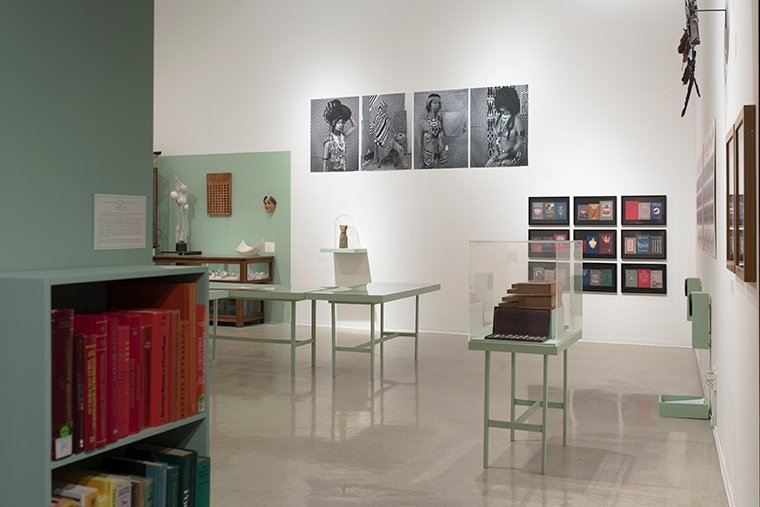
Installation view of Wunderkammer at Pitzer College Art Galleries, January 24–March 26, 2015. Photograph courtesy of Ruben Diaz.
Related Events