
Skip to main site navigation Skip to main site navigation Skip to main content
Pitzer Logo
  • Academics
    • Find Your Program
    • The Claremont Colleges Advantage
    • Design Your Own Major
    • Field Groups (Departments)
    • The Community as Classroom: Academic Experience
    • Study Abroad
    • Faculty Mentorship
    • Research
    • Academic Resources & Support
  • Admission & Aid
    • How to Apply
    • Financial Aid
    • Cost of Attendance
    • Request Information
    • Meet the Admission Staff
    • Visit
    • Digital Publications
    • Admitted Class Profile
  • Student Life
    • Living at Pitzer
    • A Student-Led Campus
    • Arts & Culture
    • Exploring Claremont & Beyond
    • First Year Experience
    • Student Support
    • Athletics & Recreation
  • Values in Action
    • Social Responsibility
    • Intercultural Understanding
    • Interdisciplinary Learning
    • Student Engagement
    • Environmental Sustainability
  • About
    • Fast Facts
    • Mission, History & The Claremont Colleges
    • Leadership
    • Strategic Vision
  • News
  • Events
  • Give to Pitzer
  • Resources for
    • Current Students
    • Admitted Students
    • Faculty & Staff
    • Alumni
    • Parents & Families
  • Directories
    • Faculty & Staff Directory
    • Offices & Centers
  • News
  • Events
  • Give to Pitzer
  • Resources for
    • Current Students
    • Admitted Students
    • Faculty & Staff
    • Alumni
    • Parents & Families
  • Directories
    • Faculty & Staff Directory
    • Offices & Centers
  • Academics
    • Find Your Program
    • The Claremont Colleges Advantage
    • Design Your Own Major
    • Field Groups (Departments)
    • The Community as Classroom: Academic Experience
    • Study Abroad
    • Faculty Mentorship
    • Research
    • Academic Resources & Support
  • Admission & Aid
    • How to Apply
    • Financial Aid
    • Cost of Attendance
    • Request Information
    • Meet the Admission Staff
    • Visit
    • Digital Publications
    • Admitted Class Profile
  • Student Life
    • Living at Pitzer
    • A Student-Led Campus
    • Arts & Culture
    • Exploring Claremont & Beyond
    • First Year Experience
    • Student Support
    • Athletics & Recreation
  • Values in Action
    • Social Responsibility
    • Intercultural Understanding
    • Interdisciplinary Learning
    • Student Engagement
    • Environmental Sustainability
  • About
    • Fast Facts
    • Mission, History & The Claremont Colleges
    • Leadership
    • Strategic Vision
  1. Offices
  2. Art Galleries
  3. Exhibitions

Isabel Beavers | Hex Hexa: forget nothing, have no dreams

September 19 – December 12, 2026
Rows of computer servers glowing green in cavernous space

A spell cast
Six corners, six figures
Between Gods and mortals
Between humans and machines
Rocks turn divine
Stones turn prophecy
Metal casts prayers
Daimons bathe

Hex Hexa: forget nothing, have no dreams is both a curse and a code. Calling back to Adrienne Rich’s 1961 poem “Artificial Intelligence,” the phrase “forget nothing, have no dreams” was a cryptic precursor to computational memory and, perhaps, to ourselves. A prophetic message, it wrestles with the simultaneous promise and threat of machinic intelligence. In Hex Hexa, this divinatory atmosphere foregrounds a tale of water, technology, and myth, with Aphrodite at its center. The exhibition transforms the gallery into a bathhouse where Aphrodite is a machinic ghost in a sleepless dream with only her memories to offer.

Hex Hexa grows out of Beavers’s research as the Hixon-Riggs Early Career Fellow in Science, Technology, and Society at Harvey Mudd College and traces the material evolution and genealogy of digital devices—from prehistoric ritual objects like gaming stones to today’s AI agents. Drawing on Greek mythology, prehistoric Cypriot ritual practices, and the legacy of copper mining, Hex Hexa examines how minerals, symbolic systems, and extractive histories underpin contemporary computational culture.

Bathhouses are sites of shared ritual, feats of engineering, and archives of history. In the Greco-Roman world, the ruins of bathing complexes (like the thermae at Kourion) illuminate historical shifts from paganism to Christianity during the Roman era and make evident the reach of the Bronze Age copper trade across the Mediterranean. They are at once sites of personal and public ritual, spiritual access, colonization, and labor. Copper mining in Cyprus, in part, fueled the Roman Empire, and it was through the copper trade that the Cypriot goddess Kypris, who was worshipped for copper and the protection of animals, became known as Aphrodite, or Venus. Hex Hexa wields the artifact of the ruined bathhouse to penetrate historic and contemporary constellations of myth, empire, technology, and material extraction. What broken bonds are engendered by excess, hubris, and homogenization? The bathhouse here is obsolete–built not for citizens but for an AI, an almost-God. Like a datacenter, like a thinking machine, it runs in perpetuity without human intervention: divining messages for no one, never sleeping, always dreaming.

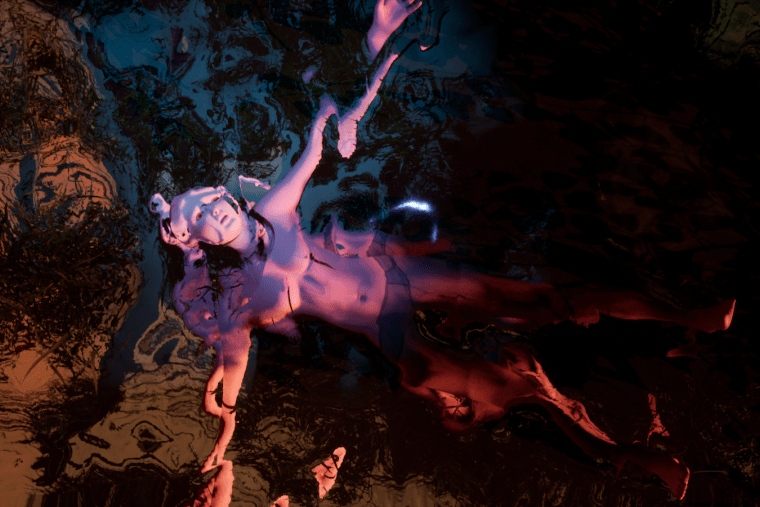
The works in the exhibition invoke elements of the bathhouse through form, material, and concept. Objects of ritual (a hexagonal fountain, an oil lamp, a stone) invite the viewer to experience the exhibition through the body, while a 3D film narrates Aphrodite’s history through fragmented dream sequences. Structured around divinatory castings and inspired by internet phenomena like StumbleUpon and the WayBack Machine, these “memories” take us to the datacenter, the copper mine, the fountain, and the island. Created using video, site-based volumetric capture, game engine simulation, and 3D animation, the film calls back to sites of Aphrodite’s mythos and to sites of copper production. The AI’s oracular messages, then, are not precognition–they are retrocognition. Failing to conjure something new, they repeat and iterate. Trade, extraction, and prophecy are knit into a hallucinatory tale.

At the exhibition’s center, a hexagonal fountain answers to sound, its bubbling water responding to the score that saturates the space. In Hex Hexa, water becomes a restless protagonist; it moves, erodes, and makes noise, behaving as a being with a will of its own. Water cleanses. It cools the world’s datacenters. It encircles the island of Cyprus, where Aphrodite was born emerging from ocean foam. Yet water is fatal for electrical and computational devices. Water is troubled by and trouble for the machine.

Hex Hexa, when spoken, is an incantation. It conjures spells and counts to six. It invokes artificial intelligence not as god or mortal but as a daimon: a vexing and opaque messenger. The exhibition questions our implicit faith in new computational tools and challenges the impacts–social, ecological, spiritual–of mega-computing. From water consumption at hyperscale, to the extraction of rare earth minerals, to social isolation, AI promises to make life more efficient and to destroy bonds between living things. Hex Hexa asks us to forgo faith and become agents of our own.
 

About the artist

Isabel Beavers (they/she; b. 1989, Boston, MA) is a transdisciplinary artist based in Los Angeles working at the intersections of new media, ecology, and collective action. Beavers is the artistic director of Supercollider LA, an Annenberg Fellow in the School of Cinematic Arts at the University of Southern California (forthcoming), and was the 2024–26 Hixon-Riggs Early Career Fellow in Science, Technology, and Society at Harvey Mudd College. A founding member of Great Pause Project, their collaborative archive is housed on the moon as part of ArchMission’s Lunar Library. Beavers’s artistic practice combines emerging technologies with in situ research and collective learning. They have led projects in Jordan as the ZERO1 2022 Creative Impact Lab - Amman Lead Artist; in Seattle, WA, as the 2021 AICAD/NOAA Art + Science Fellow; and cross-nationally as a CreaTures EU ExP Artist.

Exhibited widely throughout the U.S. and globally, their work addresses the climate crisis through myth, spirituality, and more-than-human perspectives. Beavers’s work on deep-sea mining was recently included in the Getty’s 2024 PST Art + Science Collide as part of Transformative Currents: Art and Action in the Pacific Ocean, curated by Cassandra Coblentz and Aaron Katzeman. In 2025, their anamorphic animation Sundown was commissioned by the Moving Image Media Arts (MIMA) Program of West Hollywood to premiere on The Now 3D Billboard overlooking Sunset Boulevard. Through artistic practice, teaching, and curating, Beavers fosters communities of care and experimentation, inviting audiences to sense the unseen and imagine futures of resilience.


Download the press kit for Hex Hexa.


Image: Isabel Beavers, Game Stone Sky Gaze (still), 2026, 3D film


Get More Information

Connect with Pitzer! Explore how you and our community might make a great match. Contact us, visit, apply.

  • Visit Us
  • Apply to Pitzer
  • Request Information
Pitzer College logo
location_on

1050 N. Mills Avenue

Claremont, CA 91711

Campus Map & Directions

call

(909) 621-8000

Social Media Links

  • Instagram
  • Facebook
  • X
  • LinkedIn
  • Youtube
  • Flickr
  • Careers
  • Public Health Guidance
  • Offices & Centers
  • My Campus Portal
  • Academic Catalog
  • Academic Calendar
  • Pitzer Store

Support Pitzer

Give today and help Pitzer College respond to the most pressing needs of our community now and for the future.

Give to Pitzer

© 2026 Pitzer College

  • Privacy Policy
  • Federal Compliance & Student Consumer Information
  • Accessibility Statement

A Member of The Claremont Colleges

Pitzer College admits students of any race, color, sex, gender, gender identity, religion, sexual orientation, age, creed, handicap, and national or ethnic origin, granting them all the rights, privileges, programs, and activities generally accorded or made available to students at the College.  The College does not discriminate based on race, color, creed, sex, gender, religion, sexual orientation, age, marital status, handicap, or national or ethnic origin in the administration of its educational policies, admission policies, scholarships or loan programs, athletic and other College-administered programs, or employment policies.

The Grove House seated between palm tress and clear blue skies