The Ocelots of Foothill Boulevard
January 23 – March 31, 2016
Environmental scientists have begun to refer to our current era as the anthropocene, a new geological epoch in which human activities have become the primary shapers of the earth’s environment and ecological systems, producing climate change, mass extinctions of non-human species and other significant transformations on a global scale. Whether these changes are reversible is uncertain.
On a smaller scale—such as we can observe in our neighborhoods, cities and local landscapes—anthropogenic change gives rise to surprising and unanticipated interactions among species. Mark Dion, Jessica Rath, and Dana Sherwood explore these transformations and transactions in the shifting ecotomes—or contact zones between human and non-human worlds—in the multifaceted works included in The Ocelots of Foothill Boulevard.
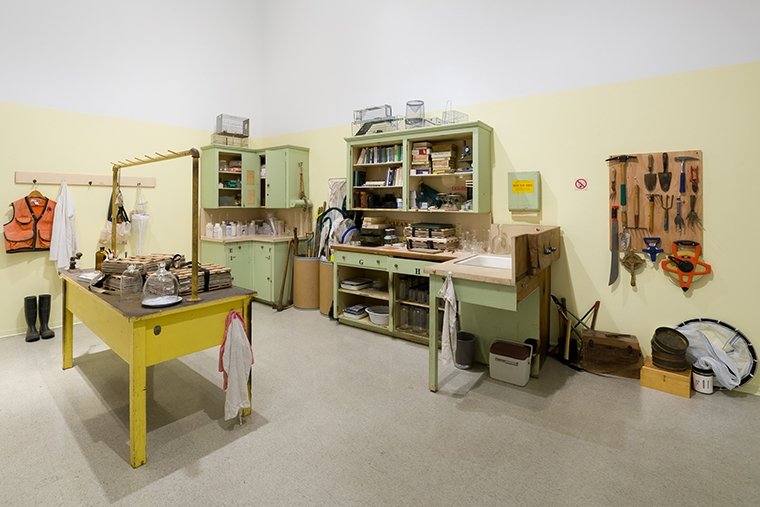
Brownfield sites and other highly polluted zones, thought incapable of yielding anything at all, have become flourishing habitats for exotic or so-called “invasive” species. Vacant office building, dead shopping malls and decommissioned military installations have become host to new flora and fauna—they are emergent “second nature” habitats in which productive interconnected multi-species communities flourish. One such site exhibiting these unforeseen interactions is the ruin of a historic infirmary, located at the foot of the San Gabriel Mountains in northeastern Los Angeles County. Built in the 1930s, it functioned for many years as a health facility for students of the Claremont Colleges. Ravaged by fires, earthquakes and other natural disasters, the infirmary was condemned and abandoned by the early 1970s. A recovering landscape, the building and the parcel of land in which it sits is today host to non-native grasses, coast live oaks, and a diverse community of biota—mammalian, avian, insect, and amphibian—as well as researchers and students who have made their homes and laboratories in and around the shuttered building.
Taking the multi-species habitat of the infirmary as a reference point, Dion, Rath, and Sherwood have excavated the shared non-human and human histories that have populated the area during the past 80 years. In addition to this local site, the artists have extended their forensic gaze to other “second nature” habitats of a terrestrial as well as an aquatic nature. Traversing time and temperate zones, these explorations, while acknowledging the deleterious effects of humans on earth, also signal the unintended value that habitat conversions and co-species habitations can have in the anthropocene.
The Ocelots of Foothill Boulevard is generously supported by art+environment, a four-year project at Pitzer College funded by the Andrew W. Mellon Foundation and the Robert Redford Conservancy for Southern California Sustainability at Pitzer College.
About the Artists
Mark Dion’s work examines the ways in which dominant ideologies and public institutions shape our understanding of history, knowledge, and the natural world. Appropriating archaeological and other scientific methods of collecting, ordering, and exhibiting objects, Dion creates works that question the distinctions between "objective" ("rational") scientific methods and "subjective" ("irrational") influences. Dion studied at the Hartford School of Art, Connecticut (1981–82, and was awarded an honorary doctorate in 2002); at the School of Visual Arts, New York (1982–84); and at the Whitney Museum of American Art's Independent Study Program (1984–85). He is an honorary fellow of Falmouth University, UK, and has an honorary doctorate from the Wagner Free Institute of Science in Philadelphia.
He has received numerous awards, including the Smithsonian American Art Museum's Lucida Art Award (2008), The Joan Mitchell Foundation Award (2007), and the ninth annual Larry Aldrich Foundation Award (2001). He has had major exhibitions at the British Museum of Natural History, London (2007); the Miami Art Museum (2006); Museum of Modern Art, New York (2004); Aldrich Museum of Contemporary Art, Ridgefield, Connecticut (2003); and Tate Gallery, London (1999). Additionally, he produced large-scale permanent commissions for The Rose Art Museum (2015); Documenta 13, Kassel, Germany (2012); the Montevideo Biennial in Uruguay (2012); the Oceanographic Museum, Monaco (OCEANOMANIA: Souvenirs of Mysterious Seas (2011); the Port of Los Angeles (2011); and The Olympic Sculpture Park, Seattle (2006). He is the codirector of Mildred's Lane, an innovative visual art education and residency program in Beach Lake, Pennsylvania. Dion lives with his wife and frequent collaborator, Dana Sherwood, in New York City and works worldwide.
Dana Sherwood is a New York–based artist whose work lies in the boundaries of the domestic and the wild and interrogates the semiotics of desire and melancholia present at the intersection of the two realms. Her work often involves organic materials and elaborate confectionery as well as interventions by animals. Since receiving a BFA from the University of Maine in 2004 Sherwood has exhibited her work at Marian Boesky Gallery, Mixed Greens Gallery, Socrates Sculpture Park, Flux Factory, The Biennial of Western New York, Prospect 2: New Orleans, Scotia Bank Nuit Blanche, The CCBB in Brasilia, as well as many other venues worldwide. In 2015, Sherwood had her inaugural European solo show at Gallery Nagle-Draxler Reiseburogalerie, and her first NYC solo show in 2016 at Denny Gallery. She currently lives in Washington Heights with her husband and frequent collaborator, Mark Dion.
Through her practice, Jessica Rath considers how we shape the aesthetics of agricultural production and of our immediate landscape. Jessica received her B.A. from University of Missouri and her M.F.A. from California Institute of the Arts. Recent solo exhibitions include the large scale projects take me to the apple breeder and a better nectar. The multimedia exhibition a better nectar focused on the symbiosis between bumblebees and the plants they pollinate (University Art Museum, California State University–Long Beach, CA, 2015) and includes a 96-page catalog detailing her collaborations and process. Based on genetic work at Cornell University Agricultural Research Station, take me to the apple breeder was exhibited at Jack Hanley Gallery (2012), Pasadena Museum of California Art (2012), and the Perlman Teaching Museum, Carleton College, Northfield, Minnesota (2013).
Rath has received mid-career fellowships from the California Community Foundation (2014), the City of Los Angeles (COLA) (2013), and recent grants from the Center for Cultural Innovation, Peter S. Reed Foundation, Metabolic Studios, and the Elizabeth Firestone Graham Foundation. Her work is included in the Center for Art and Environment Archive Collections at the Nevada Museum of Art. She is an assistant professor at Art Center College of Design, Pasadena, CA.
Curators
Bill Anthes is a professor in the Art Field Group at Pitzer College, where he teaches and writes about art in terms of multimedia practice and intercultural exchange. His current research focuses on global indigenous modern and contemporary art in the Americas, Africa, and the Pacific; decolonial methodologies for art history in settler nations such as the United States, Canada,
South African, Australia, and New Zealand; and artistic engagements with animals and nonhuman nature. He is author of the books Native Moderns: American Indian Painting, 1940–1960 (Duke University Press, 2006) and Edgar Heap of Birds (Duke University Press, 2015), and he is contributing author to the textbook Reframing Photography: Theory and Practice, by Rebekah Modrak (Routledge, 2010).
Anthes has received fellowships and awards from the Georgia O’Keeffe Museum Research Center, the Center for the Arts in Society at Carnegie Mellon University, the Rockefeller Foundation/Smithsonian Center for Folklife and Cultural Heritage, and the Creative Capital/Warhol Foundation Arts Writers Grant Program. His essays and reviews have been published in American Indian Quarterly, Art Papers, Art Journal, Exposure, Journal of the West, Number: An Independent Journal of the Arts, Visual Anthropology Review, and other periodicals, as well as numerous anthologies and exhibition catalogs, and he is a member of the editorial board of the journal American Indian Quarterly. Anthes earned master’s degree in art history from the University of Colorado and a PhD in American studies from the University of Minnesota.
Ciara Ennis is the director and curator of Pitzer College Art Galleries. Ennis received a PhD in cultural studies and museum studies from Claremont Graduate University and an MA in visual arts administration, curating, and commissioning contemporary art from the Royal College of Art, London.
Related Events
Artist lecture
Mark Dion: The Wonder Workshop, Jellyfish and Sleeping Bears
Saturday, January 23 at 2 p.m., prior to the exhibition’s opening reception
Broad Performance Space, Broad Center, Pitzer College
Vocal Performance by Cris Law
Saturday, January 23 at 4 p.m.
Nichols Gallery, Broad Center, Pitzer College
Panel Discussion
Thursday, March 3 at 2 p.m.
Broad Performance Space, Broad Center, Pitzer College
Image Caption
Installation view of The Ocelots of Foothill Boulevard, January 23–March 31, 2016 at Pitzer College Art Galleries. Photograph courtesy of Ruben Diaz.
Related Events