From Student to Contributor
Pitzer Professor Amanda Lagji encouraged students to share feedback on her book-in-progress through her interdisciplinary class, Counterinsurgency.
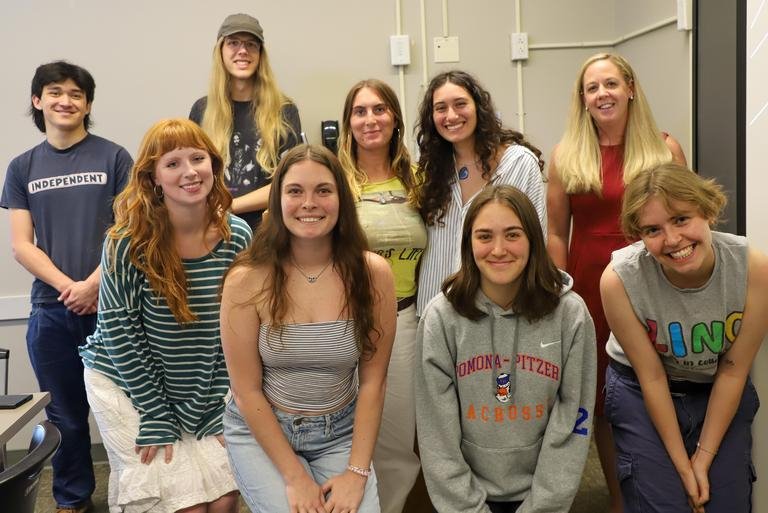
Most students read books written by their professors. Students in one Pitzer class have helped shape one before it’s published. Associate Professor of English and World Literature Amanda Lagji designed a course around her book-in-progress, inviting students into the scholarly process. They became collaborators whose questions, critiques, and perspectives helped refine Lagji’s work.
Lagji created the spring course Counterinsurgency as Pitzer’s 2025–26 Scholar-in-Residence. This annual residency supports faculty projects that involve students in developing scholarship or artistic work. Lagji’s project draws from literature, history, and politics to track counterinsurgency in colonial spaces in the 20th century.
Lagji was excited to partner with students for her work.
“We have some of the best students,” said Lagji. “They’re excellent thinkers and readers. Their feedback is incisive. It’s intellectually challenging for me to work with their critiques.”
Encouraging Student Feedback
Siena Giacoma ’27, an English and World Literature major on the creative writing track, discovered Lagji’s class when interviewing her for The Student Life newspaper last fall.
“To know our feedback was going to be taken into account was really cool,” said Giacoma. “The class was close knit and very discussion based.”
Giacoma transferred to Pitzer from a large university, where she said that she would never have a chance like this.
“It’s incredible to be able to work that closely with your professors,” she said. “That’s a very Pitzer-unique experience.”
Lindsay Ehrenpreis ’26 had a preview of the class when she worked as Lagji’s research assistant last summer. She helped Lagji draft a pitch and cull information about a suggested list of academic presses. She also read background texts so that she could offer informed feedback on Lagji’s early drafts.
“It was such a pleasure to be paid to read,” said Ehrenpreis.
Ehrenpreis enjoyed delving deeper into Lagji’s work during the class. She witnessed the incorporation of student feedback into Lagji’s writing. Such collaboration was possible because of how Pitzer encourages bold learning and critical thinking in every academic discipline.
“Pitzer is a place of socially and politically engaged thinkers, and this class is no different,” said Ehrenpreis. “It’s the epitome of a liberal arts classroom.”
Interdisciplinary Insights
Lagji’s book is tentatively titled “Counterinsurgency and the Weaponization of Time.” She analyzes how counterinsurgency and counter-terrorism interplay with imagination and power through novels.
Lagji earned master’s and doctoral degrees in postcolonial and transnational 20th-century literature from the University of Massachusetts Amherst. Raised in a global and intercultural educational tradition, Lagji passed on the same liberal arts tradition in her class.
Her students read many of the novels that she discusses in her book project. They also read military manuals and materials in philosophy and political studies. This equipped Lagji’s students to understand and respond to her work.
Lagji’s course put into practice Pitzer’s core value of interdisciplinary learning, which rings true for most classes at Pitzer. The selection committee for the Scholar-in-Residence emphasizes breadth of appeal as an important quality for class submissions.
“They encourage interdisciplinary approaches and classes that would attract students from many disciplines,” said Lagji.
An organizational studies or a political studies student would raise questions in the Counterinsurgency class that Lagji had never considered.
“Having that range of perspectives, the insights that they bring, has been really valuable,” she said.
Ehrenpreis, an English and World Literature major on the literature track and an American Studies minor, appreciated how Lagji’s class incorporated scholarship from so many subjects.
“I’ve taken a lot of classes at the 5Cs,” said Ehrenpreis. “This is the one where I read the most from other disciplines.”
Real-World Relevance
Lagji has currently organized her book around four main counter-terror logics: knowledge, preemption, profiling, and surveillance. She questions terms like “terrorist” and “insurgency” and what safety and security mean. The real-world applications are not lost on Lagji’s students.
“Professor Lagji is thinking about fiction and counter-insurgent rhetorics,” said Ehrenpreis. “We’re looking at how imagination is manipulated in service of counter-terror tactics. It’s incredibly topical.”
“I learned a lot about what it means to define insurgency and counterinsurgency,” said Giacoma. “The bad guy is never as clear to identify as I once thought them to be.”
As is the Pitzer way, Lagji confronts present-day realities in her scholarship and gives her students the tools to tackle raw social issues.
“I love being able to teach exactly the things that are preoccupying me and that excite me,” said Lagji. “We really encourage faculty to take risks intellectually and to develop courses that are literally researching what’s happening now.”
Mentorship in Action
Lagji continuously welcomed her students to share their thoughts and help make her book more accessible. Her mentorship gave students the confidence to own their voices.
“Thanks to my comfort level with her and the way I’m taught as a student to be a critical reader, I was never intimidated to critique her work,” said Ehrenpreis.
Giacoma described how she has grown as a scholar thanks to Lagji.
“She has high standards of us, and rightfully so,” said Giacoma. “It pushes us a reasonable amount.”
Giacoma always found strength in Lagji’s encouragement. She could always come to Lagji when she didn’t understand a theoretical text or part of a novel.
“She’s very personable and easy to talk to, which makes learning from her not only easy but fun,” said Giacoma.
According to Lagji, faculty mentorship is a Pitzer staple in the classroom and beyond.
“Mentoring is special here at Pitzer because it doesn’t just happen at one time or in one place but can really happen in unexpected times and places across a student’s experience,” said Lagji.
News Information
Published
Author
Bridgette Ramirez
News Type
Related News
All News