How Alicia Bonaparte Inspires and Learns From Students
The sociology professor listens to the echoes of history: ‘Our present-day circumstances have precedent.’
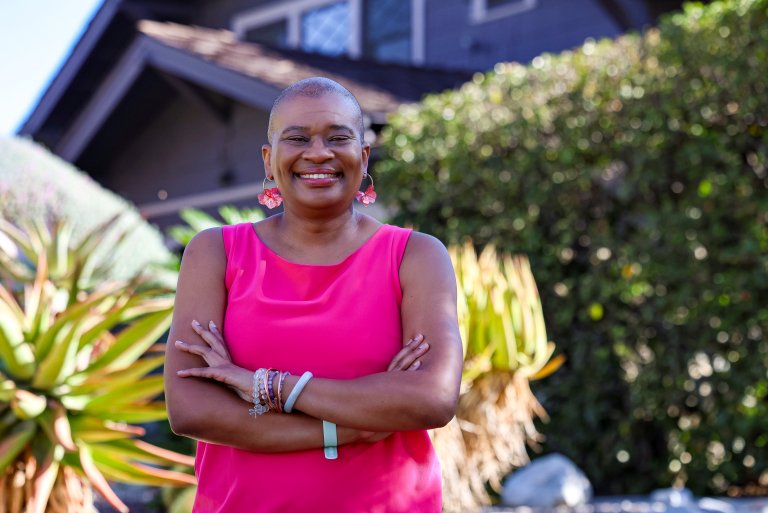
Alicia Bonaparte loves when her students connect the news of the day to her own area of scholarship. But she knows she doesn’t have all the answers.
“I see my classroom space as a collaborative learning exercise,” she said. “Students learn from me just as much as I learn from them. For example, I do this thing where I call it ‘copyrighting a student.’ If I explain something in class, and another student explains it a lot better, I'll tell the student, ‘Do you mind if I copyright you? So the next time I teach it, I can use what you said.’”
The echoes of history keep ringing out, and Bonaparte, a professor of sociology, is highly skilled at tracing their origins. She is a medical sociologist who is one of the nation’s preeminent scholars on the history of women’s health and reproductive rights in the United States, paying particular attention to the experiences of women of color. She is working on a book titled “Labors of Birthing Work: The Persecution and Prosecution of Granny Midwives in South Carolina, 1900-1940,” based on her PhD dissertation at Vanderbilt.
She co-edited, along with Julia Chinyere Oparah of the University of San Francisco, the book “Birthing Justice: Black Women, Pregnancy and Childbirth” (Paradigm, 2015). Recently she was asked by the academic publisher Sage to contribute a chapter on midwifery to a new encyclopedia focused on reproductive justice.
The Midwives’ Tale
Around 1900, about half of all U.S. births were assisted by midwives, who are trained to help women during their pregnancy, labor, and childbirth, as well as care for them and their babies afterward. Their help was especially essential for women of color, immigrants, and poor families who could not get the same level of care as white people and the well-off. As hospital births became more commonplace, midwifery became scarce. Today there are about 14,000 midwives in the U.S., according to the American College of Nurse-Midwives.
The skills of midwives are being talked about more these days, and more people are seeking out midwifery care. But people of color and people who live in rural areas don’t have access to this form of care, or maternity care in general, Bonaparte said. About 35% of counties are “maternity care deserts” with no birthing facilities or obstetric clinicians, according to the March of Dimes’ “Nowhere to Go” report released in August.
“As a result of living in a maternity desert, you may have to travel 10-15, or in many instances 30-40 miles, in order to get adequate care,” Bonaparte said. “Unfortunately, medical mistrust is a huge part of the reason why many Black birthing people wait to get care.
“It’s also about: Do I have the health literacy to navigate the healthcare system? Do I know how this insurance works? There's a history of Black birthing people being pushed to have unnecessary C-sections. It makes sense why this culture of medical mistrust is able to persist, because it's rooted in truths. It's rooted in a natural person's lived experience.
Health disparities don’t exist out of context, Bonaparte said. “I just remind my students that our present-day circumstances have precedent, and that precedent is rooted in history.”
Teaching Authentically
Menna Bizuneh, an economics professor and the associate dean for curriculum and advising, remembers when she was an assistant professor, some 12 years ago, being invited by Bonaparte to sit in on one of her classes.
“In those 75 minutes, I learned more about what the field of sociology is than I ever have before,” Bizuneh said. “It was incredible. There were eight students. The way she sets up community standards in the classroom, the way she sets up a space so that everyone has a voice ... she is amazing. Her passion is palpable. She gets so excited, and when she gets excited, she starts drawing, and her students start drawing, and she can’t stop smiling. ‘Yes! You’re learning!’”
One of Bonaparte’s former students, Sydney Gerteis ’23, now works as a Pitzer admission counselor. She took a qualitative research class from Bonaparte that had students interviewing Black mothers about their experiences and focusing on how to do so ethically. “All of her work and research just amazed me and really opened my eyes to a whole field of study that I had never even thought about before,” she said.
“I also really appreciated her authenticity, and if there was a harder day, she was still teaching ... she would acknowledge the hardness and the heaviness of what might be going on, and still be able to teach and show up, but not be fake about it.”
An Educator’s Legacy
This fall, Bonaparte is teaching two classes: Intro to Public Health, and Socialogy of Health and Medicine; there are 13 students in each, from across The Claremont Colleges.
Some of her former students want to advocate for midwifery. Others are training in the healthcare profession at institutions like Western University of Health Sciences in Pomona, Calif. She runs into them there.
“They're like, ‘Guess what? We're reading the book that we already read in your class. I've been telling my classmates how good the book is.’ Those kinds of moments just give me a large amount of delight. I planted a seed, right? And I think at the end of the day, as an educator, that's your goal. I remember when I first decided to teach, I thought to myself, ‘I'm going to influence the whole world,’ and then I realized, maybe that won't happen, but if I can at least plant seeds in students, the students will be the ones that change the world, and that will be part of my legacy as an educator.”
News Information
Published
Author
Landon Hall
News Type
Related News
All News