An Artist’s View of Her Future
For Chi Adi ’26, graduation opens up a wide world of possibilities to explore
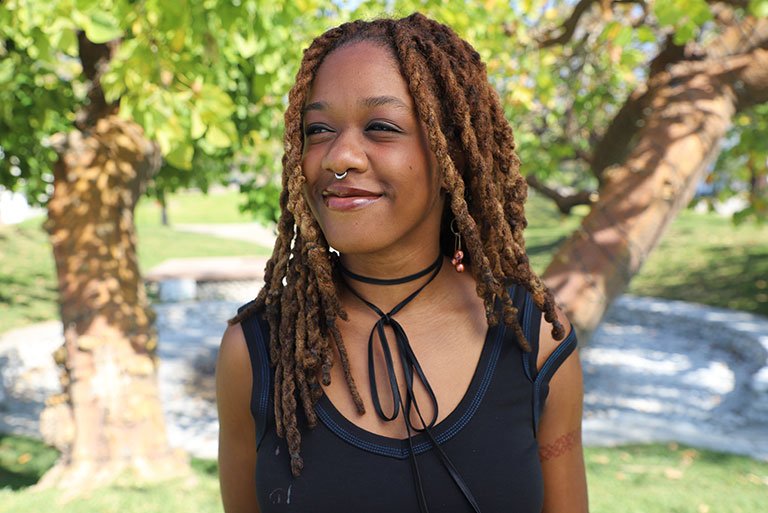
When Chi Adi ’26 imagines her life after graduation, she doesn’t see a fixed destination so much as an open field of possibilities. Artistic creation, self-exploration, and the continued development of her voice are at the center of her plans now … and whatever form they ultimately take.
“My plans are all a work in progress, but that’s good,” said Adi, who transferred to Pitzer after a brief stint with Manhattan’s The New School. “I feel confident enough in the skills I’ve amassed at Pitzer that I know I’ll be okay no matter where I end up. A liberal arts education has given me a whole host of skills to do all kinds of jobs to support me in my artistic endeavors.”
What are those endeavors? They span mixed media, installation, film, and forms she has yet to discover. For Adi, the point of her post-Pitzer plans is exploration. That openness reflects a belief she has strengthened during her time at the college: that every student should have the opportunity to find, and use, their voice.
She has done exactly that through deep involvement in campus life and governance. Adi has served as an Admission Fellow and a Writing Center Fellow, and was named a 2026 Napier Fellow for her project to produce an environmental humanities impact documentary. During her undergraduate career she has also received a Katie Lawson Award for Helping Others and was a co-recipient of a grant from the Sontag Center for Collaborative Creativity (The Hive) to revitalize a 5C club for students interested in organizational studies, her major, which she has paired with a minor in sociology.
Adi’s academic interests are rooted in her lived experiences. Before her undergraduate career, Adi attended Phillips Academy, the prestigious Massachusetts boarding school founded in 1778. The daughter of Nigerian immigrants, she took the lead in navigating the complex admissions process.
At Andover, she encountered both opportunity and inequity. Adi said she also found herself put into the role of speaking out for marginalized communities.
“I was very vocal as a student, but I felt I had to be,” she said.
After graduating, Adi moved to New York City, taking a gap year that became an important time of artistic and personal growth. She pursued film fellowships, worked a range of jobs to support herself (including one that involved her pulling stray threads out of large tapestries) and built connections in the city’s creative community.
“I was really patchworking my life together, but it was good,” she said. “I learned a lot about myself and what I was capable of.”
She later enrolled at The New School but ultimately decided to transfer, drawn to Pitzer’s shared governance model, intimate size, and its place within the Claremont Colleges consortium.
“At The New School, I saw shared governance described as an aspiration,” she said. “But at Pitzer, students are actually part of the process. It wasn’t just an idea here—it was real. That really appealed to me.”
Adi said her past experiences have helped her navigate Pitzer with confidence. “It’s a school that rewards you for being a self-starter,” she said. “Those skills—street smarts and institutional literacy—have been really transferable.”
Adi credits her liberal arts education, and especially her advisor, Organizational Studies Professor Barbara Junisbai, with helping her embrace uncertainty rather than worry about it. She has helped her treat it as a space for growth rather than anxiety.
“She’s so open to meeting you where you are, not where she thinks you should be,” Adi said. “She’s been such a great sounding board. It means so much to have her as a mentor and in my corner.”
As graduation approaches, Adi said she is waiting to hear about her application for a Watson Fellowship. But she said that she plans to spend the immediate months after Pitzer traveling and continuing to explore her artistic focus regardless of the outcome, relying on savings that she put together from past jobs. She sees the time after college not as a break from her education but as a continuation—as a chance to deepen the creative and intellectual pursuits she’s identified as an undergrad.
“It’s been a time for me to clarify my interests and how I like to work, and to plant seeds for future endeavors,” she said. “I’ve learned to see this time not as something I need to rush through, but as something meaningful in itself. What I’m doing now is discovering things for myself.”
News Information
Published
Author
Nick Owchar
Organization
- Communications & Marketing
News Type
Related News
All News