30 Years On, Prison Education Still Proves Its Thesis
Education beats incarceration: Pitzer’s Inside-Out program continues its work with new community partners.
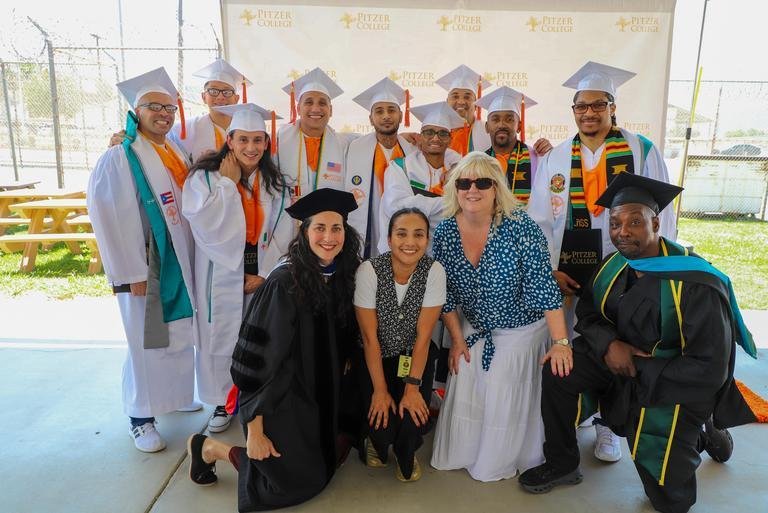
Professor Tessa Hicks Peterson taught one of the first classes that Pitzer College’s Inside-Out program ever held at the California Rehabilitation Center (CRC), the decades-old men’s prison in Norco. It was called “Healing Arts and Social Change.” That was 2014.
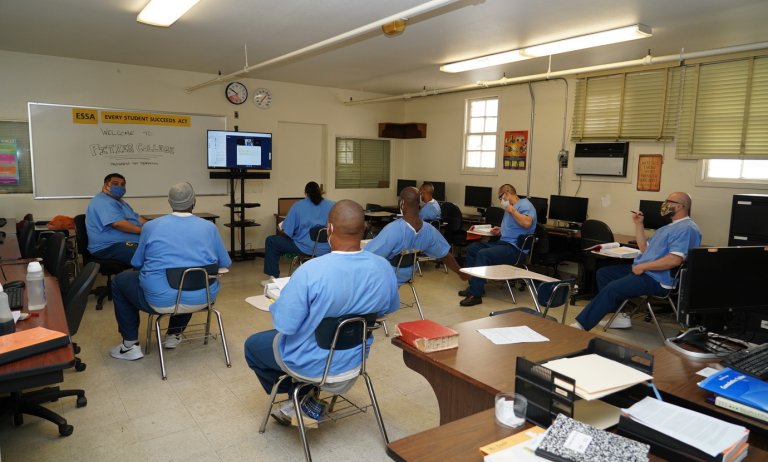
Under the model, developed by Lori Pompa at Temple University, the incarcerated students (the “inside” participants) gathered in a room at the medium-security prison to learn side by side with “outside” students and faculty from The Claremont Colleges.
That first class carried no credit, but that changed in 2016. Four years later, Inside-Out launched the nation’s first bachelor’s degree for incarcerated students. “Inside” students earned a Bachelor of Arts in organizational studies, while the “outside” students received a B.A. or B.S. in a major of their choosing.
Over the past 12 years, more than 2,000 students (inside and outside) took more than 100 courses taught at CRC by faculty from The Claremont Colleges, ranging from literature to psychology to economics to philosophy to politics.
The curriculum was designed to facilitate a reciprocal exchange of learning and connection between inside and outside students. Such a model also helps incarcerated students rebuild their lives and envision a brighter future for themselves upon their release. Among the graduates who have completed their sentences, the recidivism rate is 0%. “Which is unheard of, given that the national average is 70%,” said Hicks Peterson, a professor of urban studies at Pitzer and the interim director of the Justice Education Center (JEC) at The Claremont Colleges, which administers Inside-Out.
Although the JEC was only founded in 2018 (when it was called the Justice Education Initiative), the roots of prison education at Pitzer College back nearly 30 years. (See the timeline below.)
Owing to a shrinking inmate population in California, and to save an estimated $150 million, the state announced plans last year to close CRC, effective in October 2026. On May 19 of this year, the fifth and final cohort of 10 “inside” graduates from the Pitzer program received their degrees.
But the program marches on: This fall, 5C faculty Andre Wakefield (history), Paula Gutierrez (Spanish), Suchi Branfman (dance) and Erin Runions (religion and gender/feminist studies) are teaching classes in partnership with the California Institution for Women near Chino, as well as La Entrada transitional housing facility in Los Angeles. With GPS monitoring, the La Entrada students (who are serving the final 2-3 years of their sentences in the residential facility) are allowed to travel to Pitzer for classes.
After the first class on the campus, in September, Hicks Peterson noted the powerful emotional impact on both the inside and outside students, who are from Pitzer and the other 5Cs. Two students from La Entrada teared up during the group session. “They said, ‘I never thought I’d have this opportunity, and when I told my family, they couldn’t believe it. So you’re not just supporting me and my dreams, but my family’s dreams as well.’
“This is a transformative educational experience for the outside students too. Learning across lines of difference — race, class, religion, age, politics — in this close environment is a powerful experience that informs their views on a range of issues."
TIMELINE
1990s — Pitzer faculty members Laura Harris, Barry Sanders and Dipa Basu help lay the groundwork for Pitzer’s prison education through the creation of partnerships with community organizations including Camp Afflerbaugh-Paige, Crossroads Inc., and Prototypes Women’s Center in Pomona.
2013 — The local Prison Education Project invites Pitzer into the California Rehabilitation Center (CRC) in Norco, where students from the five undergraduate Claremont Colleges serve as tutors and mentors alongside incarcerated individuals.
2014 — Nigel Boyle, then a Pitzer professor of political studies and the founding director of the Institute for Global/Local Action & Study (and who is now an emeritus professor), launches an Inside-Out pilot program at CRC in Norco. It is based on the model developed in 1997 by Lori Pompa, a professor of criminal justice at Temple University.

2016 — Inside-Out moves under the leadership of Hicks Peterson and the umbrella of Pitzer’s Community Engagement Center. It secures Pitzer credit for incarcerated students (those “inside”).
2019 — The Justice Education Initiative (JEI) becomes a 5C effort under the umbrella of The Claremont Colleges’ Office for Consortial Academic Collaboration. The initiative receives a $1.1 million grant from the Andrew W. Mellon Foundation. Tyee Griffith becomes JEI’s inaugural director.
2020 — After years of progress and success, Pitzer’s Inside-Out becomes the first full bachelor's program of its kind in the nation to be offered to incarcerated students. Under the Inside-Out Pathway to B.A. program, “inside” students work toward a B.A. in organizational studies.
2022 — JEI meets all its goals to solidify itself as a permanent 5C academic program. It moves back to being housed at Pitzer as the Justice Education Center (JEC).
2023 — Pitzer receives a $1.1 million dollar renewal grant from the Mellon Foundation to advance the Pathway to B.A. program.
2024 — Romarilyn Ralston (Pitzer ’14) becomes senior director of JEC, using the Mellon grant to continue the center’s work beyond Inside-Out courses and into research, policy advocacy, conferences and community-based programming.
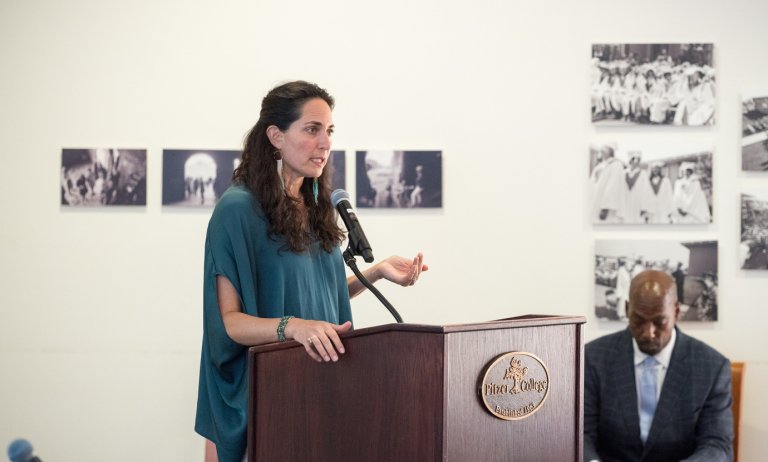
January 2026 — Hicks Peterson returns to serve as interim director of JEC to support the search for new partnerships to launch the next era of Inside-Out classes.
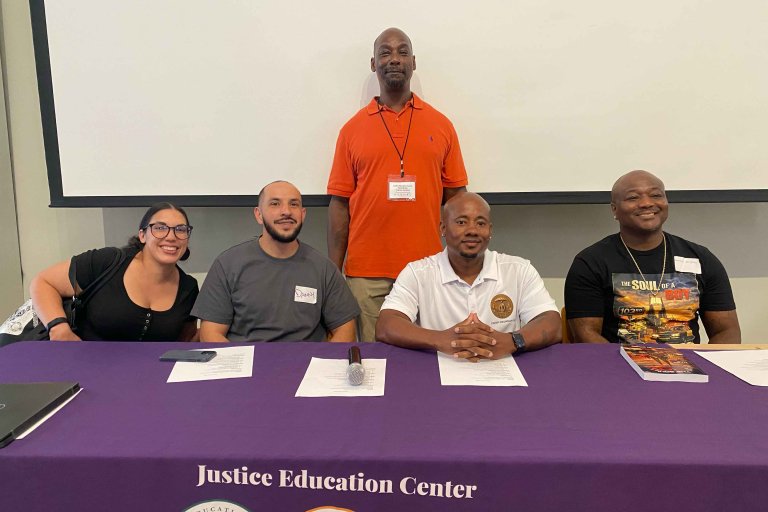
February 2026 — Kenneth Butler ’22 is appointed program assistant for JEC. Butler was among the students to graduate from Pathway to B.A. He has used his knowledge to train faculty in Inside-Out pedagogy at Temple University and around the world, visiting 16 countries to facilitate prison-education programs.
May 2026 — The fifth and final cohort of incarcerated CRC graduates from the Pitzer program receive their B.A. degrees.
September 2026 — The first cohort of incarcerated women from the La Entrada transitional housing facility in L.A. attend their first class on the Pitzer campus. The program also is teaching classes to incarcerated students at the California Institution for Women near Chino.
News Information
Published
Author
Landon Hall
Organization
- Justice Education Center at the Claremont Colleges
News Type
Share This
Related News
All News