Flipping the Script on Wildfire
A new report from Pitzer’s Robert Redford Conservancy argues Southern California must rethink how it understands fire, land stewardship and year-round risk.
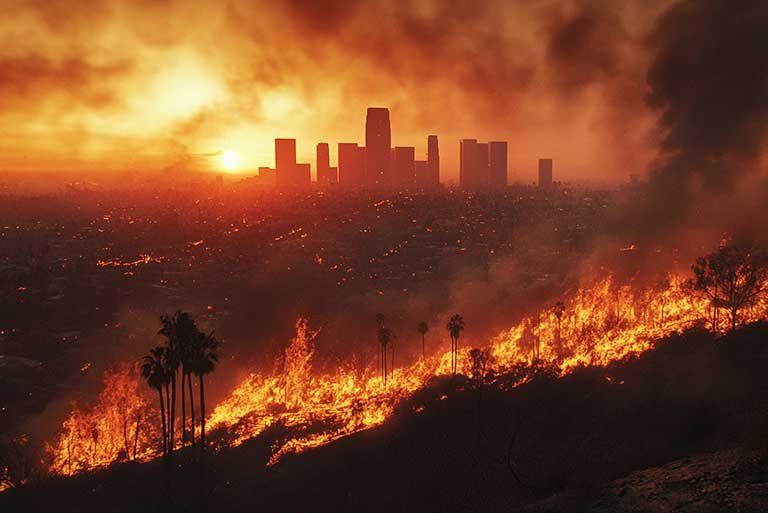
In Southern California, wildfire “season” is traditionally described as running from roughly April through October. But according to researchers at Pitzer College’s Robert Redford Conservancy for Southern California Sustainability, the phrase itself no longer reflects reality.
The data tells a different story: fires are no longer seasonal. They are year-round.
That conclusion sits at the center of Flip the Script, a new fire report recently published through the Conservancy’s SoCal Earth initiative, an Esri-based online environmental dashboard. The report combines decades of wildfire data with striking visualizations designed to challenge common assumptions about fire in Southern California.
“I think people understand, especially after the Eaton and Palisades fires of 2025, how pervasive a part fires play in our everyday life in every season,” said Conservancy Director Susan Phillips. “What we’ve done in the report is show this in a very compelling way by looking at every single day of fires in Southern California over the last 70 years.”
The report’s graphics, developed by recent graduate Nathan Lu ’25 using publicly available CalFire data, illustrate the dramatic increase in wildfire frequency across the region over time. In some recent years, particularly from the mid-2010s onward, the visualizations show near-continuous fire activity in California as a whole and Southern California in particular.
The images are intentionally difficult to ignore.
“They’re stunning graphics,” Phillips said. “It’s all right there unfolding in front of you.”
A Closer Look at the Wildland-Urban Interface
Beyond showing the growing frequency of fires, the report also challenges widespread misconceptions about where and why wildfires become destructive.
The project emerged in the aftermath of the devastating Eaton and Palisades fires of January 2025. Phillips said she became interested in claims that the fires had spread into entirely new areas of urban development—and that the wildland urban interface didn’t matter in such windy, tinderbox conditions. To test that assumption, she overlaid maps of the fires onto maps of the region’s wildland-urban interface, which refers to areas where human development overlaps with undeveloped natural landscapes.
What she found surprised her.
“With very small exceptions, the fires were almost entirely bounded within the wildland-urban interface,” Phillips said.
The finding reinforced an important point emphasized throughout the report: wildfire risk is not necessarily expanding into unfamiliar territory as much as human development continues pushing deeper into landscapes historically prone to fire.
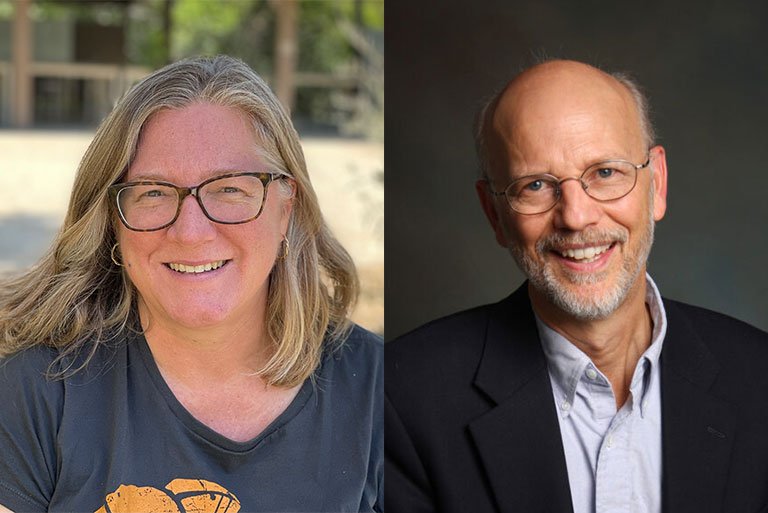
What the report shows conclusively, says co-author Char Miller ’75, a professor of environmental analysis and history at Pomona College, “is that Los Angeles is built to burn. More than one million people live in the region’s fire zones, so it is no surprise that the Palisades and Eaton fires — and their analogues across time — were so devastating.”
“You can’t be dismissive of the wildland-urban interface because of flying embers and wind,” Phillips explained. “It remains an extremely good predictor of where wildfire will touch communities.”
That realization gradually expanded into the report’s broader mission. Phillips said many colleagues living in foothill communities reached out after the fires asking practical questions about safety, preparedness, and what homeowners should realistically expect in the future.
“We realized we needed to write something for homeowners who just wanted to know what to do and how to understand fire in a different way,” she said.
An Uneasy Coexistence
At its core, Flip the Script argues for a major shift in how Southern Californians think about fire itself. Rather than viewing wildfire as an occasional disaster that interrupts normal life, the report frames fire as an intrinsic part of the region’s ecology, as something that communities must learn to coexist with rather than simply suppress.
That shift, Phillips argues, also requires rethinking land stewardship, urban planning, and regional coordination.
“We completely lack a mechanism for regional planning,” she said. “Everything is in the hands of local municipalities, so coordination across the region is one of the biggest challenges.”
Because land-use decisions are fragmented among numerous cities and agencies, Phillips believes Southern California struggles to respond cohesively to environmental threats that transcend municipal boundaries.
A solution, Miller says, is for the county and/or state to buy land in the interface from willing sellers. “The idea is to pull people to safety before a disaster occurs; in a post-fire scenario, buying up land parcels would help create a buffer for future fires.”
That’s why the report calls for greater investment in stewardship-based approaches to land management, including ecological restoration, infrastructure improvements, and land-care jobs that focus on long-term environmental resilience.
“We have to shift our relationship to land and land stewardship,” Phillips said. “We are part of this world.”
Expanding Public Understanding
While Phillips and Miller see promising signs in recent climate planning efforts and policy discussions across the region, they believe meaningful change will require a broader cultural shift that involves ordinary residents, not just policymakers or fire experts.
That democratizing impulse is central to both the fire report and the larger SoCal Earth project.
“The fire report is our response to these problems,” Phillips said. “You need to be informed. You need to understand what is happening and what basic patterns look like. That’s the first step.”
She hopes the report’s accessible visualizations and explanations will help broaden public engagement around wildfire, climate resilience, and regional planning.
“These are not conversations that should be confined to policymakers and fire experts,” she said. “Everybody needs to be involved in this. Everyday people need to act in coordination with each other.”
News Information
Published
Author
Nick Owchar
Organization
- Robert Redford Conservancy for Southern California Sustainability
News Type
Share This
Related News
All News