A Scavenger Hunt in Kathmandu
Madison Wilson ’26 describes an experience that changed her understanding of herself and Nepal.
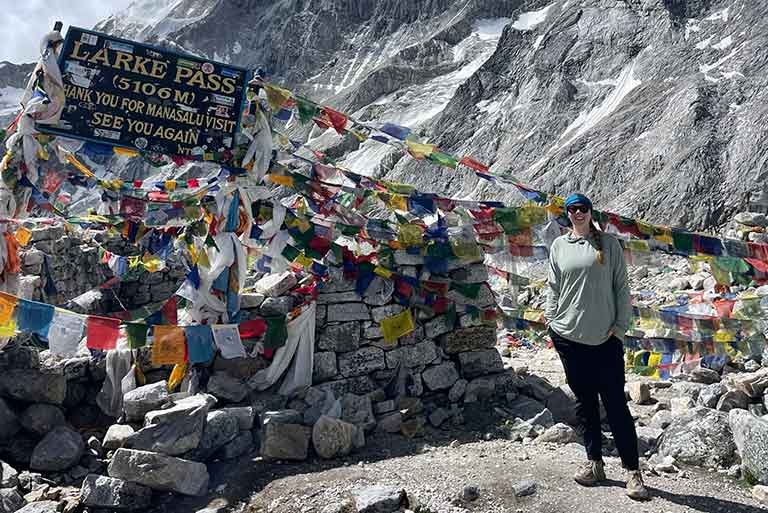
Editor’s note: The study abroad experience at Pitzer emphasizes language immersion, homestays, community engagement and independent research while helping students gradually develop the skills and confidence to navigate new cultural and linguistic environments more independently.
That was certainly the experience of Madison Wilson ’26 during her semester in the Pitzer in Nepal program. In the following account, Wilson describes her experience navigating the city of Kathmandu all on her own.
For current parents and families interested in Pitzer’s programs, get more information about study abroad application deadlines.
One morning I left my house in Kathmandu’s Balkot neighborhood not with my usual school bag, but with an empty side bag, tense shoulders and my stomach full of nerves.
It was only my first month in Kathmandu, and the city felt like an overwhelming labyrinth — noisy, sprawling, buzzing with life and traffic I couldn’t yet decipher. The day before, I had gathered all the courage I had just to walk down the road to the snack shop and try to buy a single Kit Kat, a packet of biscuits and one apple. I had rehearsed my line over and over in class: “Namaste! Kati rupiyaa parchha?” (“Greetings! How much does this cost?”) But when the shopkeeper quickly rattled off a number in Nepali, my mind blanked. I froze, smiled awkwardly and asked, “Pheri bannus?” (“Say again?”)
After confusing the numbers pacchas (50) and pacchis (25), I eventually handed over the correct amount of rupees and hurried out with my snacks. That felt like a major step.
So, when our teachers announced a city-wide scavenger hunt the next morning, it didn’t feel like another step—it felt like something far bigger and far more intimidating. The instructions were simple in theory, overwhelming in practice: go to an unknown mystery location, purchase about 20 items — many of which I didn’t recognize — and return by 1 p.m. I thought we’d at least be going in pairs or small groups. I was wrong. Looking back, I can see our teachers had designed the exercise to help us begin navigating Kathmandu more independently while building on the skills we had already been developing during our first weeks there.
We each drew a card with a location name. Mine said: Ghanta Ghar. I looked it up on Google Maps, assuming it was a building or maybe a clock tower or a museum. It showed up as a dot in the middle of Kathmandu city. Okay, I thought, once I arrive there, I’ll figure it out. I can ask what things are — that’s kind of all I can do right now.
We would be making our way there using Kathmandu’s public transportation system. This time, though, there would be no familiar cluster of classmates moving through the city with me. That meant navigating honking motorcycles, shouting conductors and packed microbuses that didn’t stop so much as slow down just enough for you to launch yourself in or out. It was chaotic, confusing and — to someone whose previous college programming, even the “adventurous” ones, had taken place within the neatly organized bounds of a group led closely by faculty or program staff — completely uncharted.
Creating a Sense of Independence
While I had always been highly visible as a foreigner in Nepal, I felt truly exposed for the first time. Before, that visibility had always come with a layer of protection. There were other highly visible students in our group, and we traveled together. During our first weeks in Nepal, our teachers, host families and program structure had helped us gradually build what we needed to begin navigating daily life more independently. But now, for the first time, I had to rely much more directly on those emerging skills myself. Now, there was no one waiting at the other end. No teacher or classmate beside me. No one around me knew who I was or why I was here.
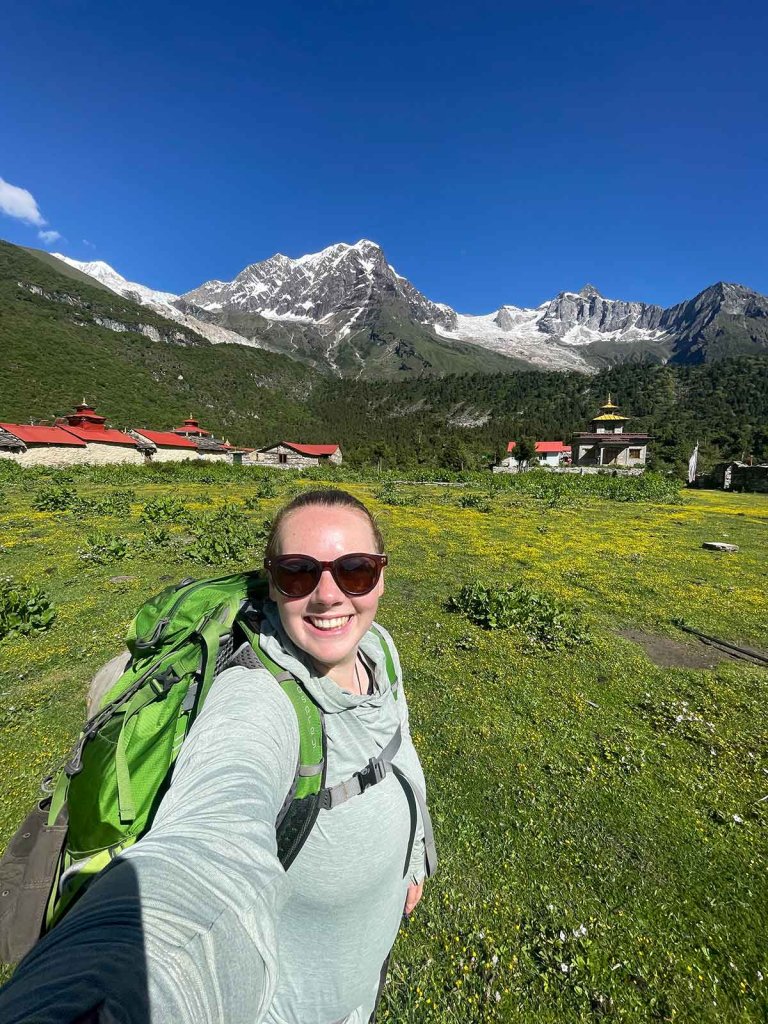
Too nervous to start alone, I walked with one of my classmates in search of a bus stop. At Kosultar, we crossed the pedestrian bridge and were instantly surrounded by bus conductors shouting destinations. I couldn't tell which bus went where, and none of them looked like the city buses I was used to — more like minivans with 15 people somehow packed inside or giant buses with colorful designs and blaring music. One man shouted “Bhaktapur!” so I jumped on. I figured I had at least 10 minutes before my stop, but just a few minutes later, the conductor turned to me and said, “Ghanta Ghar!”
I wasn’t ready. I stepped off onto a dusty roadside. This wasn’t a place. There was no museum. No tower. Just streets, shops and people. I tried to pull up my phone, but my battery was nearly dead. It started to rain lightly, and the streets turned muddy. For a few panicked minutes, I wandered aimlessly, doubting everything. But then I noticed the small things: fruit vendors everywhere, people bargaining in Nepali, small shops around me. I realized that Ghanta Ghar isn’t a landmark. It’s an area.
I took a deep breath and walked up to a fruit stand. “Kerra chha?” (“Are there bananas?”) I asked before wincing internally and thinking, of course there are bananas — I'm looking at them right now! I recovered and asked, “Ek darjan kerra kati rupiyaa parchha?” (“How much does a dozen bananas cost?”) and made my first purchase of the day. One down. Then I pointed to my list and asked, “Yo ke ho? Yo kaha chha?” (“What is this? Where is this?”)
Getting to Know the Locals
Every shopkeeper I met that day was patient with my fumbling Nepali and occasional English. I felt clumsy, slow, but never laughed at or unwelcome. The more I asked for help, the easier it became. I stopped trying to Google things and started reading shop signs instead. By the time I had only one item left on my list —a kaapi (notebook)— I wasn’t confident, but I was comfortable. Every time I asked for kaapi, people pointed me toward coffee. After a dozen confused exchanges, a woman overheard me and turned to her young son. “Help her,” she told him.
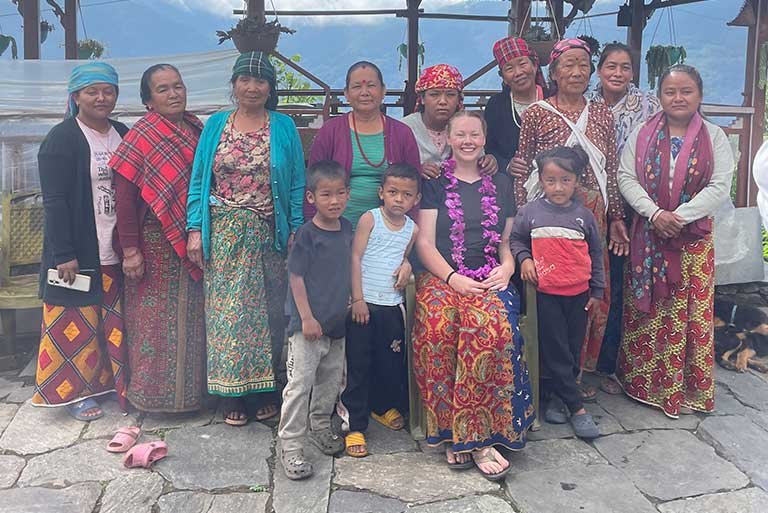
The boy led me to a tiny bookstore where I finally found a small notebook. Then, to my surprise, the woman invited me over for tea. Normally, accepting a stranger’s invitation to go to their home might’ve been unthinkable. But my spirit of embracing new, uncomfortable experiences, her warmth and the way her son helped me led me to accept.
Their home was just next door. I met her husband — a professor of environmental science at a Tribhuvan University campus — and her mother-in-law. We sat in their living room, sipping hot milk tea, speaking in a mix of Nepali and English. We talked about our families (one of the only conversation topics I was proficient in) and school. They taught me new Nepali words and corrected my grammar. We laughed. I practiced the few verbs I had memorized. I felt like I had walked through a barrier — like I was no longer just observing Kathmandu but beginning to be part of it.
An Important Turning Point
Eventually, I realized I should head back. I retraced my steps, took a bus to an intersection, where I decided to walk the final 25 minutes back to the program house. My feet were sore. My brain was fried. But I wasn’t just relieved — I felt accomplished. Somehow, I had done the thing I was afraid of. And I typically don’t feel intimidated by new situations. And more than that, I had actually enjoyed it.
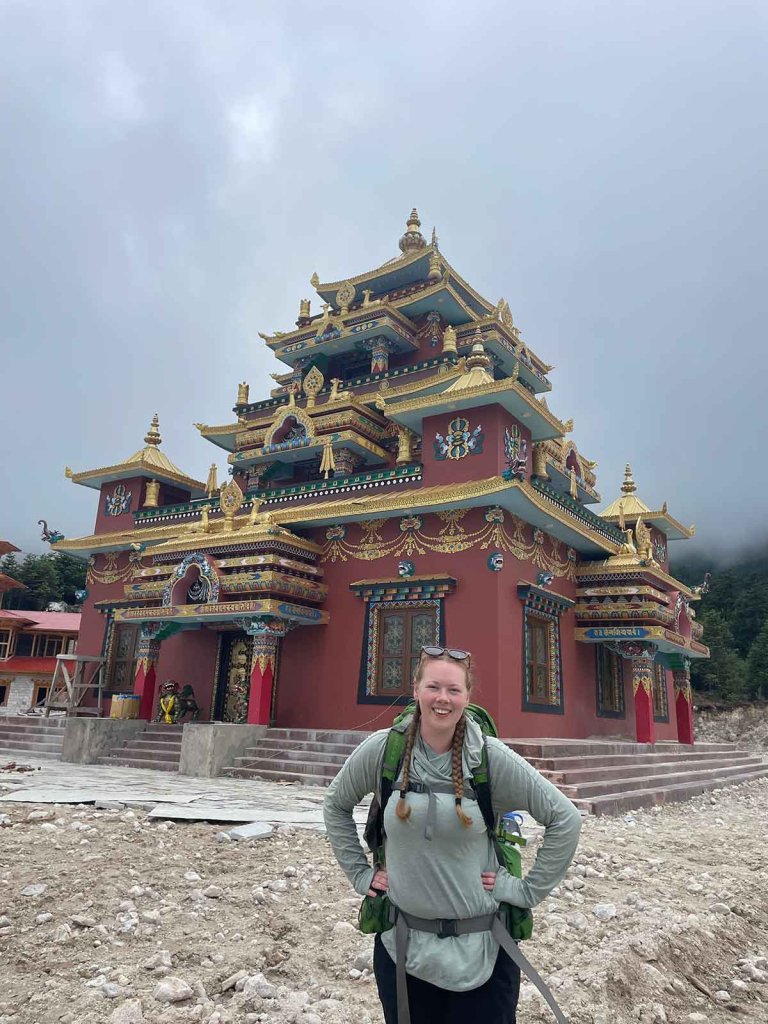
That day stayed with me long after the scavenger hunt ended. It marked a quiet but important turning point in my relationship with Nepal. Up until then, I had been engaging with the country through a carefully designed structure, which I appreciated and even needed. But that structure had also kept me slightly insulated. I was learning about Nepal but had not yet learned how to move through it independently. Being lost, confused and entirely on my own was the first time Nepal stopped feeling like a carefully structured educational experience and started feeling like daily life. And in some strange, unexpected way, I felt like I belonged to it more. Not because I knew what I was doing — I didn’t. But because I had to learn how to navigate not just as a student completing a task, but as a person figuring out how to exist here.
And Nepal, in return, met me with patience, warmth and the kind of unexpected generosity — like being invited into a stranger’s home for tea — that made me feel not just tolerated, but welcomed. After that, I started paying attention differently. I started trusting that it was okay not to know something as long as I was willing to ask. I became less obsessed with understanding everything before stepping out the door, knowing I could keep moving even when I didn’t have all the answers.
News Information
Published
Author
Nick Owchar
Organization
- Study Abroad and International Programs
News Type
Related News
All News