Mindful of a Green Future
A look at various sustainability efforts pursued by the college community in 2025-26
Learning Through Action
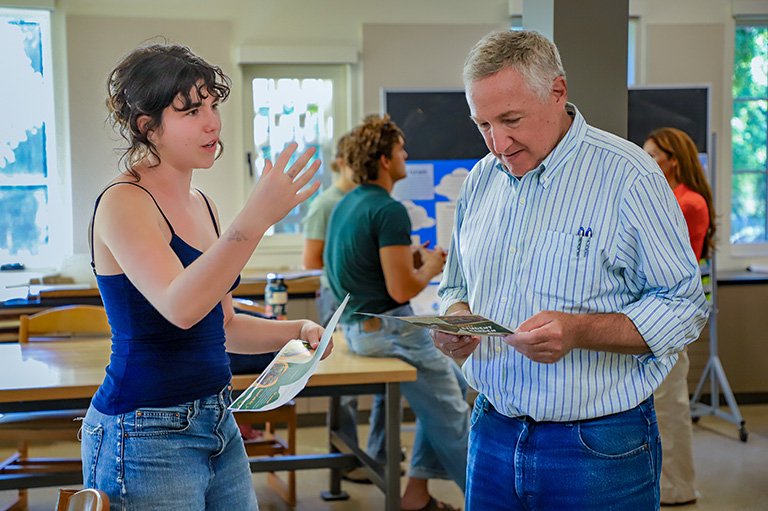
Student engagement remains central to Pitzer’s sustainability work. Through the Robert Redford Conservancy for Southern California Sustainability, student fellows led environmental education workshops for more than 100 advanced placement science students from local high schools, introducing core ideas around water conservation and environmental stewardship. Conservancy fellows also shared their work with members of the Pitzer Board of Trustees during an open house (pictured: Student Garden Manager Mia Teicher ’27 with Trustee David Good P’20).
On campus, students continue to play hands-on roles in applied sustainability projects. The student garden supports a farm-to-table model, supplying herbs, eggs, and vegetables for Grove House’s student-run kitchen, while other student-led initiatives combine advocacy, research and community engagement.
Community Engagement
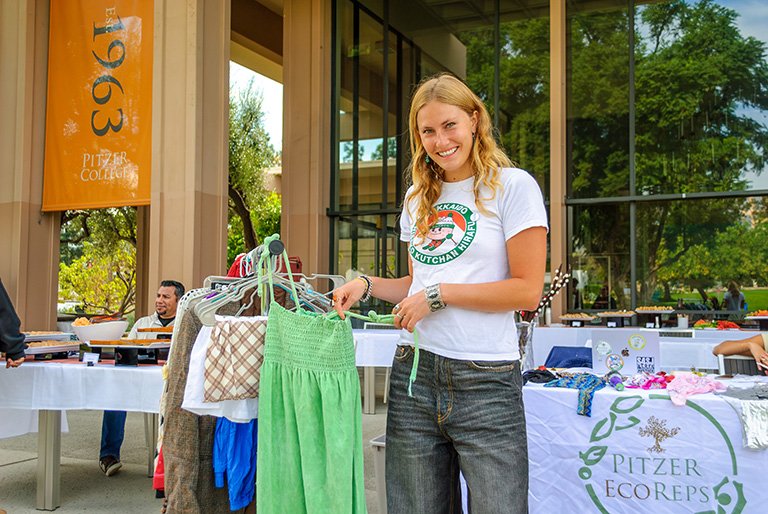
Student leaders continue to play a vital role in cultivating a culture of sustainability. Pitzer EcoReps have organized programs such as EcoFest, ReRoom, Pass-It On Pitzer, and the McConnell Dining Hall composting initiative, diverting food waste to local urban farms. Other efforts to build awareness include sustainability fairs held at campus locations, including the McConnell apron (pictured). At the consortium level, the Conservancy is working with 5C sustainability groups to support student-led environmental initiatives.
Leadership and Institutional Commitment
In fall 2025, Pitzer’s Board of Trustees approved a new long-term strategic vision that positions the college as a leader in environmental sustainability, alongside its commitments to justice-centered education and student success. To support this vision, the college launched the development of a comprehensive Sustainability Plan that embeds accountability, measurable goals, and funding pathways across departments. A newly formed sustainability plan working group — made up of faculty, staff and students — is now helping shape priorities and guide implementation.
Responding to Wildfires with Art and Tech
Following the Eaton Fire in Altadena, Pitzer deepened its commitment to climate response through creative practice. With a $20,000 gift from the Pepper Family Foundation, the college hosted a residency last summer for artists who lost studios in the fire, providing access to campus resources and creative spaces.
This work currently continues with the Activist Artist-in-Residence program. For 2025–26, artist Cienna Benn is collaborating with students, faculty, and community partners to document and preserve Black life and legacies in Altadena. Her project, “Alta-Heirloom: West Lake Memories,” explores archives as both a social and institutional practice.
As the one-year anniversary approached of the devastating Southern California wildfires, the Conservancy also promoted the section of SoCal Earth’s dashboard about fire resources. This section not only presents a historical look back at the past 70 years of wildfires in the region, it’s also a proactive guide. The Conservancy team hopes to change how Southern California communities think about wildfires and to better understand the ways that urban settings interface with the region’s wildlands.
Sustainable Campus Operations
Pitzer has integrated sustainability into daily operations through energy-efficient upgrades, EV charging stations (Pitzer is the only school in the consortium to provide this for free), water-saving infrastructure, and a tree restoration effort that planted more than 25 native trees in the past year. Recent work includes upgrades for classrooms and offices as well as for the Nucleus complex (including 124 sustainable features in the LEED Gold-certified Nucleus West building). New EV charging stations in the Sanborn parking lot on the west side of campus are providing additional support to our community; the lot also has received energy efficient lighting,including occupancy sensors; a storm water management provision, including permeable paving; and water-saving drought-tolerant landscaping.
Research and Innovation
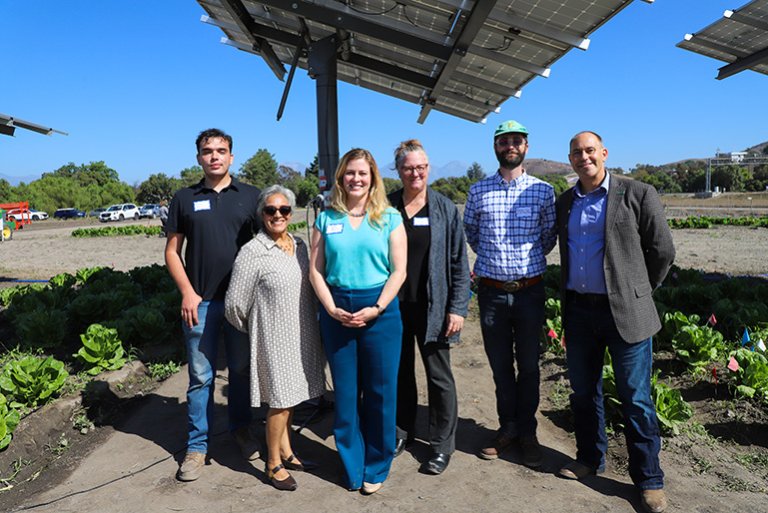
In partnership with Cal Poly Pomona, Pitzer’s Conservancy last fall launched Southern California’s first agrivoltaics research site — an innovative model that combines solar energy production with crop cultivation on the same land. Supported by a multimillion-dollar grant, the project advances climate-resilient agriculture while providing research opportunities for students and faculty across disciplines.
The teams at the Conservancy and Cal Poly Pomona’s Huntley College of Agriculture welcomed California Agriculture Deputy Secretary Virginia Jameson to visit the installation at Spadra Farm. Jameson delivered keynote remarks at the unveiling, telling attendees that installations like this one “really give me hope for the future of agriculture in California. This project is a microcosm of what farmers do every day. They wake up with the sun and try to figure out ways to do things better.”
This year faculty and students at the Conservancy have continued to develop and broaden awareness about SoCal Earth, a publicly accessible climate-mapping platform created with Esri. With support from the Eileen and Harold Brown Foundation, the tool provides updated data on pollution, food security, habitat loss, and wildfire risk, helping communities better understand environmental challenges.
Learn more about this research on the Conservancy's agrivoltaics page.
News Information
Published
News Type
News Topics
Share This
Related News
All News