A Constructive Form of Rebellion
The story behind Pitzer's first student mural
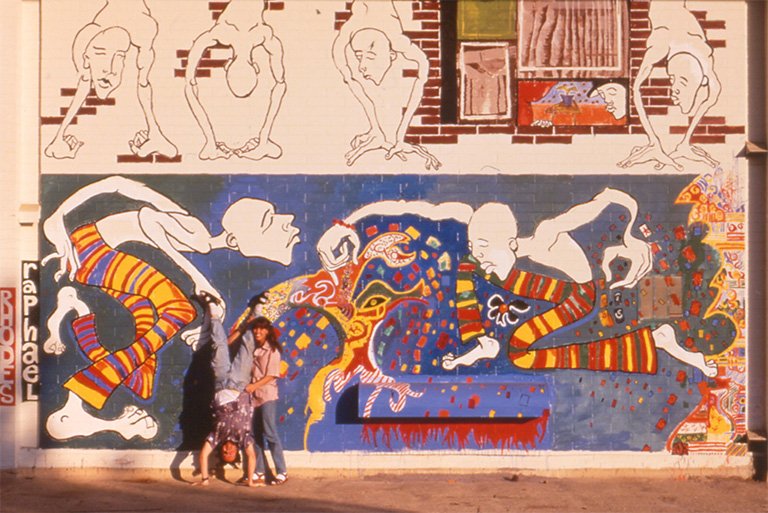
Pitzer’s first student mural began as an act of protest.
One night in fall 1995, Aaron Rhodes ’97 and Darci Raphael '97—who are credited with painting the mural above Mead Hall’s west-facing entrance—made a decision with their friends: We need to paint a mural. Right now. Rhodes recalled how, earlier that year, another student had been caught painting a mural and was threatened with expulsion. If that hadn’t happened, Rhodes said, the campus might never have had any murals at all.
At the time, the campus mood was tense as the student body pushed the administration to allow freedom to create what they called "spontaneous art." Red stars and other smaller images appeared all over campus (and were soon painted over) to spur student activism and debate. Students rallied around the message that, “they can expel one of us, but not all of us.” Raphael and Rhodes decided to paint something that would be on a larger scale—and hopefully more permanent.
“It was spontaneous and intentional,” Rhodes said. “This was about expressing our frustration, and there were a lot of creatives in our group—artists, writers, musicians, photographers. So, painting a mural seemed like a great way to do it.”
Raphael led the design, creating a bold mural celebrating free expression. “Her artistic style is unmistakable,” Rhodes said. “The characters in the mural came straight from her broader body of work—I was a supporting brush.”
Later that night, after campus security officers and a dean told them to stop, Raphael continued, standing on Rhodes’ shoulders to paint the higher parts of the mural. Peter Harper ’97 reassured everyone that the pair would be careful. The Mead mural would spark campus debates, town halls and articles in The Other Side urging the administration to support student expression.
“It turned out to be a tipping point," Rhodes recalled. "In the end, it opened up a big conversation about student expression and what it means to have creative freedom.”
“It was one of the greatest moments in Pitzer history,” Harper added.
That campus conversation eventually led the administration to permit murals on the columns of the walkways once surrounding The Mounds. Something was set in motion that would ultimately shape the College’s public art policy.
For Rhodes, it’s deeply satisfying to know that a night of rebellious creativity helped spark a lasting culture of public art at Pitzer. His one regret is that Raphael is no longer here to see it. She passed away last year, coinciding with the mural’s 30th anniversary.
Today he sees the creation of the mural differently than he did as a student.
“What it represents now is even more meaningful than what it meant then,” Rhodes reflected. “I see it as a symbol of the kind of education Pitzer supports. Our mural became a metaphor for what constructive rebellion can look like when it’s done in service to a larger idea.”
News Information
Published
News Type
Related News
All News