The Fabric of Life
Like her critically-acclaimed quilts, VP for Academic Affairs and Dean of Faculty Chawne Kimber has threaded together many elements to create a richly dimensioned career
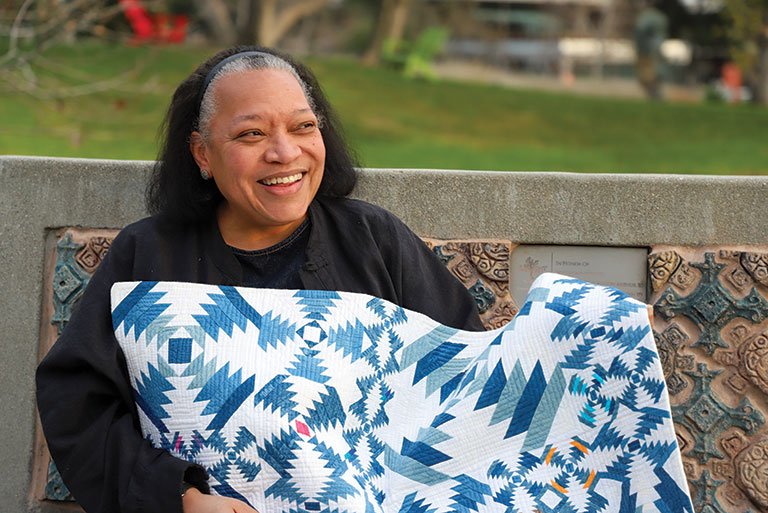
Not many artists can say their quilt is in the Smithsonian American Art Museum. Fewer can say that they also happen to be a mathematician, activist, and higher education leader. Chawne Kimber, who is Pitzer College’s vice president for academic affairs and dean of faculty, is one of the few who can do just that.
Since her arrival last summer, Kimber has supported Pitzer faculty and students in pursuing five core values: social responsibility, intercultural understanding, interdisciplinary learning, environmental sustainability, and student engagement. Her experience practicing these values over the course of her career informs how she is leading and facilitating community at the college.
“As a Black woman in math, I’m a bit of a unicorn and had quite varied experiences with my classmates and with my professors,” said Kimber. “I realized that I didn’t want to have the same sort of negative effects on my students.”
Previously Kimber served as dean of the college at Washington and Lee University and oversaw 21 departments and 13 interdisciplinary programs. Prior to her tenure there, she was the Thomas Roy and Lura Forrest Jones Professor of Mathematics and head of the Mathematics Department at Lafayette College, where she helped to build a culture of inclusivity and innovation in STEM education.
“In my classes, I wanted to make math relevant,” said Kimber. “I would teach social justice issues and how to measure justice and opportunity in my classes. I did it so students could take away a bag of tools to be better humans in their communities.”
Kimber said she was drawn to Pitzer because of “the social justice mission of the institution and the actual practice of social justice and social responsibility that the students are required to do as part of the curriculum.”
Social Justice in Quilting
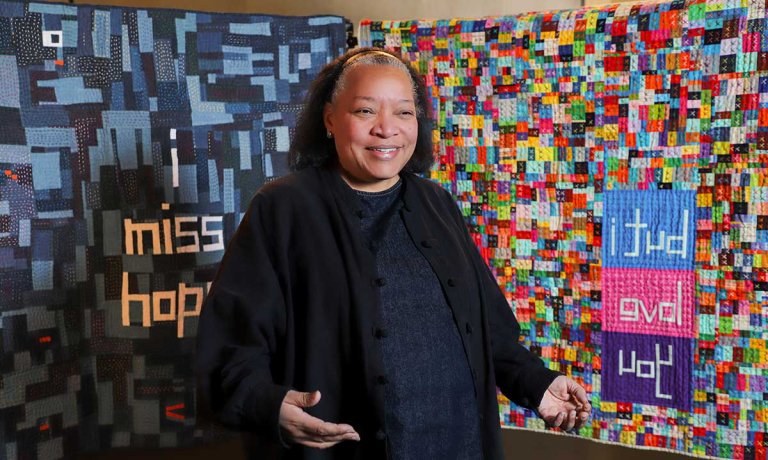
Art, quilts, and family heritage inspired Kimber in her own social responsibility practice. She grew up surrounded by her great-grandmother’s quilts, which were her father’s prized possessions. He recounted to her how his grandmother, Mamo, would work with other women on a large quilt stretched out on a frame. As a child, he would sit under the quilt and push the needle back up for them.
“He would tell stories of when, if he was super quiet, he could learn all the gossip of the community because the ladies would forget he was under there,” said Kimber.
To repair quilts, Kimber’s family made do with old clothes they found around the house. Those family quilts were “actually more of a sculpture because you’d have patches on top of patches after the quilt had been used for a while,” she said.
Kimber picked up quilting as a form of self-care when she was a professor. Sewing offered relief from stresses generated by her job. However, quilts meant more to her than comfort. Her family members were human rights activists as well as quilters.
“I grew up in a household where every human being is valued,” she said.
Kimber asked herself how her quilting could confront social issues. One of her most famous quilts, “still not,” evokes her enslaved ancestors’ history of picking cotton in Alabama and her present experience as a Black woman in America. The Smithsonian’s website references that quilt’s duality: “[Kimber’s] family participated in quilting circles to chat, cry, laugh, think, and mend — to create a home together. Mamo’s story was told through her quilts, and Kimber continues the thread.”
In her artistic practice, Kimber has created many other quilts in which she unravels complex emotions and ideas. Even when her quilt addresses a heavy topic, quilting is cathartic for her. She encourages young activists to find a catharsis that works for them.
“Most of the battles we’re fighting right now are not quick,” said Kimber. “They are long term. I’m thinking marathon, not a sprint. … There are days where you have to understand that you’re not the only one who can solve a problem, that there is an army of people behind you, and that you can take a break.”
Preparing Students to Change the World
Kimber’s passion for equipping the next generation of changemakers is something Pitzer professors share. She admires their focus on “getting these students out the door as some of the strongest and most passionate citizens of the world that I’ve ever met.”
“You don’t do that by hiding yourself and writing your book,” added Kimber. “You have to be interacting with the students every day — and sometimes on really hard days where students are testing boundaries as part of their social responsibility education.”
Kimber balances two roles. As the dean of faculty, she partners with the faculty to support students. As the vice president for academic affairs, she stewards the college’s long-term needs.
“A liberal arts student can ... pull together one-dimensional solutions to make them multi-dimensional.”
“Some decisions that are really awesome for the faculty have to be mediated by reality,” said Kimber. “And so, there are times when I have to walk a really thin line between these two to make sure that I am still fully supporting the faculty, while also making sure Pitzer is still here in the future.”
Kimber collaborates with faculty, staff, and students through the college’s shared governance system. All stakeholder groups have a say in running the college. Kimber said this sense of ownership in the college is rare in higher education. She believes the liberal arts model also sets Pitzer students apart as problem solvers.
“A liberal arts student can see things from multiple perspectives and pull together one-dimensional solutions to make them multidimensional,” she said.
Pitzer’s core values enhance how students implement their educations. Kimber had a hard time picking a favorite one, but social responsibility has a special place in her heart. It’s because of this core value that students engage in community-driven learning.
“We were out there doing service in the community as children, and it is part of who I am,” said Kimber. “And so, students being part of the Claremont and Ontario community, it’s just one of those sources of pride.”
Watch a Video Interview with Chawne Kimber
News Information
Published
Author
Bridgette Ramirez
Organization
- Dean of Faculty
News Type
Related News
All News