Leading in Data Justice and Intercultural Learning
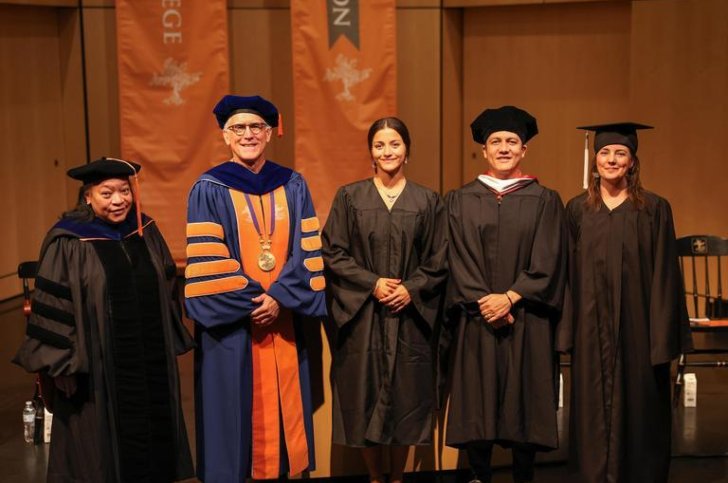
Pitzer student Anya Sharma ’26 uses her mathematical economics major for social good with support from faculty and campus resources.

Numbers and equations intimidated Anya Sharma ’26 as a high school student. She never imagined she’d flourish as a mathematical economics major and a data justice champion. Yet that’s how she finds herself now at Pitzer College.
Sharma, who is also a data science minor, first saw STEM as a tool for community advocacy during Associate Professor of Mathematics Jemma Lorenat’s Data and Justice class. It opened new possibilities for Sharma’s post-grad aspirations.
“I was able to see how to apply data analytical skills and coding for good,” said Sharma.
With support from the Pitzer Internship Fund, Sharma later interned for Witness to Mass Incarceration Inc. in summer 2025. She worked on a database that mapped businesses owned by formerly incarcerated people or others affected by the carceral system.
“I was able to see my mathematical economics education come to fruition,” said Sharma. “I was working toward a system that would benefit people.”
Encouraging Confidence and Academic Explorations
Sharma believes she wouldn’t have pursued STEM if not for Pitzer’s faculty mentorship opportunities and other academic resources. Pitzer offered a safety net for Sharma to experiment.
“Coming to Pitzer was a fulfilling and enriching academic experience,” she said. “I was able to create relationships with faculty that I didn’t even see on my horizon in high school. The small student-to-faculty ratio has given me so much more confidence as a student.”
Sharma considers her humanities coursework — from creative writing to history to anthropology — to be “infinitely valuable for every facet of life.” The liberal arts enrich how she applies math and economics to real-world issues.
“When you’re doing mathematical economics at Pitzer, you’re thinking about the current system and how we can make it better,” said Sharma.
Sharma’s interdisciplinary education has prepared her with a flexible approach to career planning. After she graduates this spring, she intends to pursue work in economic development, data analysis or technology in the service of social justice.
Multicultural Community Building
Her curriculum is not all that has set up Sharma for success. Her role as student lead at Pitzer’s Center for Asian Pacific American Students (CAPAS) has proved transformative.
“I started as a shy person,” said Sharma. “As I’ve worked at CAPAS, I’ve grown into my role as a leader.”
At CAPAS, Sharma has learned how to collaborate with others, manage budgets and organize campus-wide events.
“CAPAS has a nonhierarchical structure,” said Sharma. “It’s about understanding group dynamics and identifying strengths of people and how we can contribute to a broader picture.”
CAPAS raises awareness about issues facing the Asian Pacific Islander Desi American community. It’s one example of how Sharma has seen Pitzer’s core value of intercultural understanding in practice.
Sharma grew up surrounded by people who looked like her but didn’t necessarily share her values. By contrast, Pitzer connected Sharma with a diverse community with the same passions that she had. She built on this multicultural learning experience by studying abroad through the Pitzer in Nepal program.
“That experience has given me so much to learn about different cultures and people,” said Sharma. “I’ve come to understand how people’s stories come together and how we’re all so similar and so different. Our similarities and differences make who we are as part of this bigger puzzle.”
News Information
Published
Author
Bridgette Ramirez
News Type
Related News
All News