Climate Action in Los Angeles
Pitzer Professor Adrian Pantoja mentored two students who co-authored research with him about how Angelenos perceive and react to environmental justice issues.
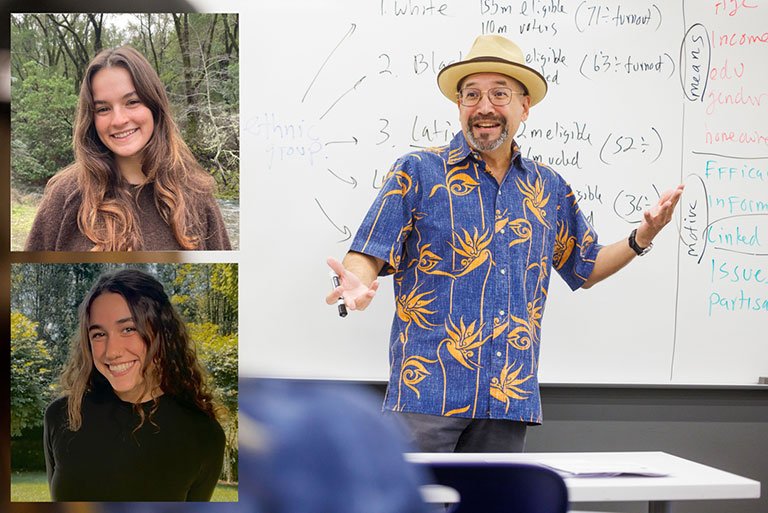
Greater concern for climate change doesn’t always lead to pro-environmental action. In Los Angeles, demographics affect environmental attitudes in surprising ways. Professor Adrian Pantoja partnered with two students to unpack this reality in a piece published in the Social Science Quarterly (SSQ).
Pantoja, Journey Lipscomb ’24, and Sami Gottsegen ’25 recently published “Identity and Wildfire Risk: Race, Ethnicity, Gender, and Climate Change Attitudes in Los Angeles” in the SSQ academic journal. Lipscomb and Gottsegen participated in the work with support from Pitzer’s JF Harmon Faculty/Student Research fund.
Lipscomb double majored in political studies and environmental analysis at Pitzer. She enjoyed combining her learning from both majors under Pantoja’s guidance.
“I was always curious about the complex dimensions of climate attitudes and political behavior in Los Angeles County, and conducting research with Professor Pantoja was an invaluable opportunity to integrate those topics and tackle a real-world issue through original analysis,” said Lipscomb.
Pantoja, who is a professor of political studies and Chicano studies at Pitzer, values his students’ contributions to his research. He credited Lipscomb and Gottsegen for how their interdisciplinary perspectives expanded his approach to the research project.
“Faculty collaborations with students beyond the classroom are a hallmark of a Pitzer education,” said Pantoja. “I am grateful to be a professor at Pitzer College where I have the opportunity to collaborate with passionate, creative, and brilliant students like Journey and Sami.”
Understanding Identity and Environmental Justice
Pantoja, Lipscomb, Gottsegen, and their additional co-authors analyzed Los Angeles Public Opinion Survey responses for their research. According to their paper, Latina/o, Black, and women survey respondents had the highest climate change risk perceptions. However, these same groups were less willing to pay more for clean energy.
Why the disconnect? Pantoja and his co-authors have several theories. One is that these groups tend to face more economic challenges and prioritize more basic needs. The paper concludes that we need more research about sentiments toward a wider range of pro-environmental activities. The paper also encouraged policymakers to treat clean energy adoption with nuance and awareness of economic and social inequities.
“Los Angeles and other global cities have an opportunity to be leaders in the fight for global climate change,” wrote Pantoja and his co-authors. “But effective action and policies require the diverse voices and perspectives that are characteristic of these cities.”
Passion meets purpose when Pitzer faculty and students collaborate on research. Gottsegen and Lipscomb have applied their hands-on experience in environmental justice to their careers.
Gottsegen, who was an organizational studies major at Pitzer, now works as a base-building organizer at ONE Northside. Meanwhile, Lipscomb is a research associate at the Environmental Law Institute.
“Working on [the project with Professor Pantoja] introduced me to what the research process looks like in a rapidly developing issue and allowed me to develop empirical skills that I have continued to utilize, both as a student at Pitzer and as a professional,” said Lipscomb.
News Information
Published
Author
Bridgette Ramirez
News Type
Related News
All News