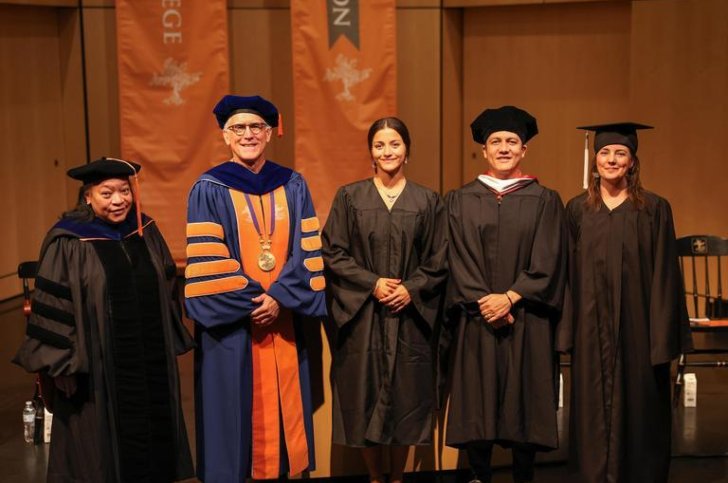
Changing the System From Inside
Stella Stringer ’26 Will Take her Investment Banking Experience and Apply It to Global Sustainability Challenges

Spending her childhood in Zambia changed everything for Stella Stringer.
She said that living in Lusaka, the capital city, gave her an experience richly different from what might have been if she’d been a child in an American city. While her parents, both OBGYNs, worked with a non-profit organization on HIV and AIDS research, Stringer and her two siblings attended an international school that included students from 46 different nationalities.
“Life moves at a slower pace, and children are less over-scheduled,” she said. “There’s a strong sense of community, and you learn to appreciate and depend on the people around you.”
As Stringer looks ahead to her graduation this spring, she is preparing to join Wells Fargo as an investment banking analyst in the renewables and utilities space based in Charlotte, NC. The pace will be different, she acknowledged, but she sees the role as a training ground for the impact she hopes to have in renewable finance.
That space is an evolving area that focuses on generating, transmitting, and distributing essential services (primarily energy and water), with a significant and growing focus on transitioning from fossil fuels to clean, naturally replenished energy sources. Stringer wants to be a part of it; she said she’s eager to understand more about the financing issues and challenges facing companies seeking to make that transition. Her interest in this area was piqued by her summers as an undergraduate spent as an intern for a hydroelectric power project in Zambia.
“I learned a lot about how the industry works,” she said. “Last summer in Zambia, I was on the project side, while this summer in Charlotte I was on the financing side. I think it was very valuable to see it from both perspectives, the company’s and the bank’s.”
While investment banking is often associated–perhaps thanks to movies and pop culture–with individuals who accumulate wealth for wealth’s sake, Stringer has other goals in mind. It all points back to her Pitzer experience, she explained, and her positive experiences collaborating with the administration.
“At Pitzer I’ve been able to get quite a lot done by working through the system and making change from the inside,” she said of her efforts, including a current five-year sustainability action plan she hopes the College will adopt before she graduates. “That’s the same approach I want to take to the energy sector.”
At Pitzer, Stringer led a push to shift dining hall food waste away from industrial composting facilities and toward local, community composting. In spring 2025, the College began distributing that food waste to local farms—an effort that now receives official funding support from the administration. She also cofounded Pitzer’s EcoReps, a group of students who work with the College and the student body on sustainability initiatives. Their projects include ReRoom, a program that collects unwanted items from students at the end of the year–furniture, supplies, and more–and redistributes them to the campus community and local area at low cost or for free.
“I’ve spent my time at Pitzer figuring out how to move an institution,” she said. “Now I want to take those skills and apply them on a bigger scale.”
Investment banking was something she was told by a variety of people—including Mia Diamond ’25, an investment banking analyst who helped her with the process of applying to Wells Fargo—that she’d need to understand before moving into the area of renewable financing and helping companies to acquire more renewables and to develop renewable projects.
“My analyst job is definitely not my endpoint,” she said. “I think that it is just a place where I’m going to learn what I need to be successful in this field and make the largest impact. Ultimately, I don’t know yet what my final endpoint will be, but this is going to be an important stop on the way there.”
News Information
Published
Author
Nick Owchar
Organization
- Communications & Marketing
News Type
Related News
All News