
Fireflies & Medicine: Professor Aaron Leconte Awarded $503,298 NIH Grant
Aaron Leconte and his students in the Department of Natural Sciences of Pitzer and Scripps Colleges are researching a firefly enzyme’s potential as a biotech tool for human health.
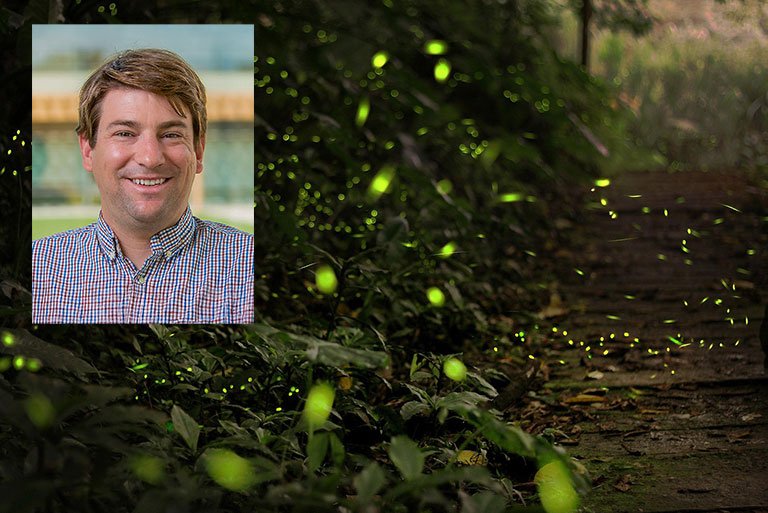
In the hands of Professor of Chemistry Aaron Leconte, the source of a firefly’s glow is a biomedical tool. The National Institutes of Health (NIH) has awarded Leconte, a faculty member in the Department of Natural Sciences of Pitzer and Scripps Colleges (DNS), with a $503,298 grant to explore firefly luciferase’s potential in observing biological processes.
The NIH’s three-year R15 grant will support Leconte and his student researchers in their project, “High-throughput characterization and engineering of brighter luciferases.”
Leconte said that the NIH grant will fund student salaries, instrumentation, and materials for the next three years. He credited many students for contributing to the luciferase research over the years—including Scripps alums Hana Burgess SCR’21 and Anjali Mamidwar SCR’20 championing the idea behind project’s latest phase. Leconte was also grateful for Pitzer alum Marcell Simon ’23, who wrote the grant application as a post-baccalaureate research fellow in his lab.
“This project could not have happened without an amazing group of creative, curious, hardworking students!” said Leconte.
Firefly luciferase is the most common light-emitting enzyme used for Bioluminescence Imaging (BLI). BLI is a non-invasive method to monitor biological events, cells, and molecules.
In the project description, Leconte explained that “BLI assays consistently [exceed] fluorescence-based methods in the context of deep tissue or whole animal imaging applications. Thus, BLI is a critical imaging tool for whole animal imaging applied to both the study of diseases as well as in the evaluation of potential therapies.”
Leconte’s project was first awarded support from the NIH with an R15 grant from 2019 through 2023. In the prior award, Leconte’s team used novel biochemical methods, computational data analysis, and robotic laboratory automation to dramatically increase the speed with which they could evaluate the impact of amino acid changes on luciferase. With the 2025 grant, Leconte and his students are applying these biochemical methodologies to previously understudied parts of the protein.
Currently, luciferase only works well for imaging single biological events or molecules. In the project’s latest phase, Leconte and his team seek to engineer the enzyme so that imaging applications can monitor multiple cell types at once. Leconte will focus on probing luciferase’s C-terminal domain to discover more ways to improve and advance the protein’s functionality.
In this project and others in his lab, Leconte encourages his students to ask creative biochemical questions and advance medicine by participating in interdisciplinary science research.
Along with the work they’re doing in Leconte’s lab, many students have been co-authors on scientific publications. They have described work in the Leconte lab in journals such as Biochemistry, ChemBioChem, and more.
News Information
Published
Author
Bridgette Ramirez
Organization
- Department of Natural Sciences
News Type
Related News
All News